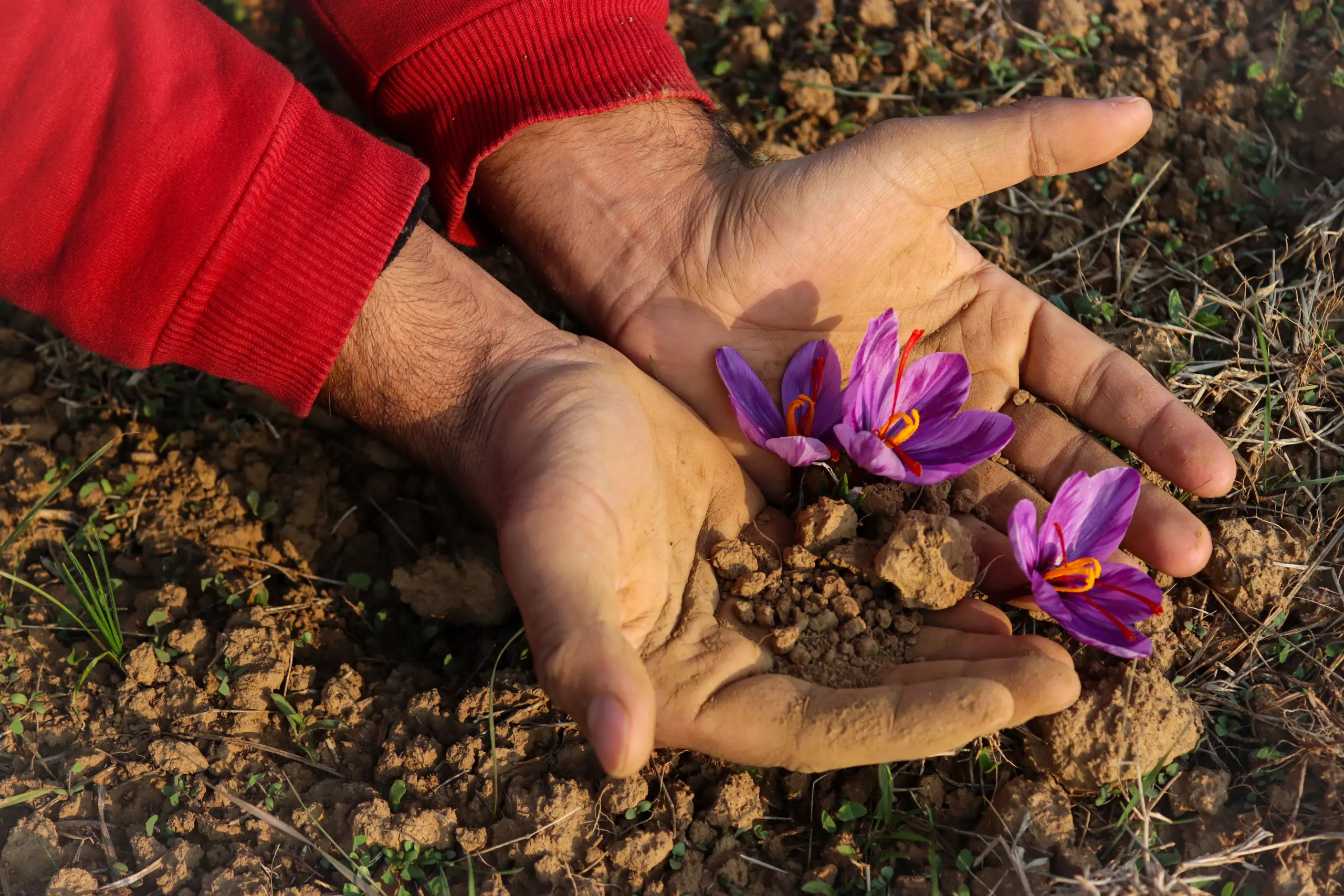
A Kashmir saffron harvest tour is best planned for late October to early November, when Pampore’s crocus fields usually offer the highest chance of fresh blooms and a real picking experience. From Srinagar, you can do it as a taxi day trip, add Avantipur and Awantipora on the same route, and return without needing an overnight stay.
When saffron blooms in Pampore and best visiting window for a Kashmir saffron harvest tour
Pampore, in South Kashmir’s Pulwama district, is the best-known saffron-growing belt in the valley. The harvest is highly seasonal: flowers are usually seen in the last week of October and the first half of November, but the exact bloom window shifts each year depending on rainfall, soil temperature, and how early the cold arrives. If you are planning a Kashmir saffron harvest tour, the safest strategy is to target the second half of October and early November rather than relying on a fixed date.
The saffron flower is delicate and short-lived. In practical terms, this means the “right day” matters more than almost any other autumn outing in Kashmir. If you reach Pampore too early, fields may still be quiet. If you go too late, much of the bloom may already be picked. For visitors, the best time of day is early morning, when flowers are freshly open and harvest activity is most visible. Morning light also gives better photos and makes the field visit feel more authentic.
For planning purposes, think of the season in three phases. The first phase is the build-up in mid-October, when local growers prepare for picking and the fields are readied. The second phase is the main bloom window from late October into the first days of November, which is usually the peak period for a Kashmir saffron harvest tour. The third phase is the tail-end in early to mid-November, when some fields still show flowers but the intensity reduces quickly. Weather can compress or stretch these phases, so a local confirmation close to travel day is very helpful.
If your trip is flexible, keep one spare morning open. A saffron visit is one of those seasonal experiences that rewards patience. Unlike a garden or monument, the timing is not fully fixed, and the bloom can change in a few days. That is why a taxi-first plan from Srinagar works well: you can leave early, check the field condition on arrival, and continue to other stops on the same route if flowering is lighter than expected.
For official background on the region and travel context, Jammu & Kashmir Tourism is a useful starting point: J&K Tourism official website. For a broader reference on the town and its saffron association, see Pampore and saffron.
How to plan a Pampore saffron field trip from Srinagar
For most visitors, the best Kashmir saffron harvest tour begins in Srinagar and runs south along the main road toward Pampore, Avantipur, and Awantipora. Pampore is roughly 15 to 20 km from Srinagar city, depending on your starting point and the exact field location. The drive usually takes around 30 to 45 minutes one way in normal traffic. If you start from central Srinagar very early in the morning, the trip is straightforward and comfortable as a half-day outing.
Taxi is the most practical way to do this trip because saffron fields are not a simple walk-in sightseeing stop with clear public transport links. A private Srinagar to Pampore round trip for a half-day visit is commonly quoted in the general range of INR 1,800 to INR 3,500, depending on vehicle type, waiting time, and whether you add extra stops. If you extend the same route to Avantipur and Awantipora, expect the fare to move upward, especially if you keep the car for 4 to 6 hours. Always confirm whether tolls, parking, and waiting time are included before starting.
There is usually no formal entry fee for viewing saffron fields from public-access areas, but you should respect private farmland and local instructions. Some fields may be on or near cultivated land where access is controlled by the owner or village community. Parking is generally informal and roadside rather than at a large paid lot. Keep small cash ready in case a local handler, guide, or field owner charges a modest fee for access or a short guided walk, though this varies by season and exact location.
The best itinerary is simple: leave Srinagar early, reach Pampore near sunrise or shortly after, spend 45 to 90 minutes at the fields, then continue to the heritage stops on the south Kashmir route. This timing gives you the highest chance of seeing people at work and flowers still fresh. For a Kashmir saffron harvest tour, an early start also helps you avoid later road traffic and gives you more daylight for photos and side visits.
Recommended taxi-first timing
If you are doing only Pampore, leave Srinagar around 6:30 to 7:00 am in late October or early November. If you want a more relaxed tour with the heritage stops, leave by 6:00 am. That gives you enough time to spend the morning in the saffron belt and still return to Srinagar by early afternoon. Families, older travelers, and photographers usually prefer this pace because it avoids rushing between stops.
A sensible same-day plan is: Srinagar to Pampore field visit, brief stop at Avantipur, a look at Awantipora, lunch on the way back or in Srinagar, and return to the hotel. If you want to deepen the day with a garden or pilgrimage add-on, the route can also be linked with a longer south Kashmir excursion. For example, if you are interested in a temple-focused extension later in your trip, you can combine your planning with a Srinagar to Kheer Bhawani Temple taxi service on a separate day rather than forcing too much into one route.
What to expect at the fields
A good saffron visit is not a commercial “show” in the usual sense. You are more likely to see working farmland, local families picking flowers by hand, and small bundles being collected for stigmas. That makes the experience more meaningful, but it also means you should behave like a guest in a farming area. Ask before stepping into a row, avoid trampling the beds, and do not pluck flowers unless you are invited to help. The whole point of a Kashmir saffron harvest tour is to see real seasonal work, not staged tourism.
Bring comfortable shoes, a light jacket for the cold morning air, and a phone or camera with a good close-up mode. The mornings can be chilly in late October, especially before the sun fully rises. If the weather is overcast, the flowers still photograph well, but the ground may be damp. Keep your itinerary flexible, because a windy or rainy day can shorten the visible bloom period and reduce the harvesting activity.
If you want to pair the trip with a slightly longer south Kashmir circuit, a garden stop later in the day can work nicely during another season, but for this specific autumn trip the main emphasis should stay on the saffron fields. If you later decide to stretch the outing toward the hillier parts of South Kashmir, the Srinagar to Achabal Garden taxi service is better suited as a separate, fuller day because it adds distance and road time beyond a focused saffron itinerary.
Nearby stops: Avantipur, Awantipora, and South Kashmir route
One of the strengths of a Kashmir saffron harvest tour is that it fits naturally into the South Kashmir road corridor without wasting time. The two closest heritage stops are Avantipur and Awantipora, both of which are commonly visited on the same day as Pampore. They add historical depth to the trip and break up the drive, while keeping the journey seasonal and efficient.
Avantipur
Avantipur is about 21 to 24 km from Srinagar, with a one-way drive time of roughly 35 to 50 minutes depending on traffic and your exact route. It is best visited in the same morning as Pampore, ideally after the field visit when you are already on the southbound road. There is usually no major entry fee for a casual stop at the ruins, though parking may be informal and local conditions can change by season.
The site is known for its old temple ruins and makes a good heritage pause if you want your saffron trip to feel broader than agriculture alone. The best time to stop is late morning, after the fog lifts and before the road becomes busier. If you are traveling with elders or children, keep the visit short and focused so the day remains comfortable. Taxi fare impact is minimal because Avantipur sits on the same route and only adds a small amount of waiting time.
Awantipora
Awantipora is practically on the same corridor as Avantipur and sits around 20 to 25 km from Srinagar, again with a drive time of roughly 35 to 50 minutes from central Srinagar depending on starting point. In many itineraries, visitors use “Avantipur” and “Awantipora” interchangeably, but in practice the roadside stop is a convenient heritage break on the way to or from Pampore. There is usually no formal ticket required for a quick look at the ruins, though you should always confirm any local access rules on arrival.
The best time to visit Awantipora is after your field visit, when the morning is already active and the road is open enough to continue without delay. For a Kashmir saffron harvest tour, Awantipora works best as a 20 to 30 minute stop rather than a long museum-style visit. It is valuable because it gives structure to the drive and helps turn a simple field outing into a well-rounded South Kashmir day trip.
South Kashmir route planning
The South Kashmir route from Srinagar to Pampore and onward toward Avantipur or Awantipora is one of the easiest seasonal taxi circuits in the valley. In clear weather, the full day can be done comfortably within 4 to 6 hours if you keep the focus on saffron and heritage stops. If you add more sightseeing, the duration increases quickly, so it is better to keep this specific autumn itinerary tight and purposeful.
For most travelers, the sweet spot is a half-day trip with an early start, a field visit at Pampore, one heritage stop, and a relaxed return. The total taxi cost usually stays manageable because the route is short by Kashmir standards. If your group is larger, a sedan is enough for most couples or small families, while an SUV makes sense for groups carrying extra layers, cameras, or elderly passengers who want more comfort on the return drive.
This route is also ideal if you want to avoid the crowded, general-purpose autumn tours that only focus on chinar leaves. A Kashmir saffron harvest tour gives you a more specific seasonal experience: flowers, harvest work, rural landscape, and heritage in one short road trip. That distinct identity is exactly what makes it one of the most interesting autumn outings from Srinagar.
FAQ
When is the saffron harvest season in Kashmir?
Saffron harvest in Kashmir is generally a late-October to November experience, with exact bloom timing changing by weather and elevation. For the best chance of seeing flowers, plan around the second half of October and early November, and confirm locally before traveling.
Where should I go for saffron fields near Srinagar?
Pampore in South Kashmir is the classic saffron area near Srinagar. A taxi day trip can combine saffron fields with Avantipur/Awantipora stops, making it a practical half-day or full-day outing without needing an overnight stay.
Can saffron harvest be combined with other autumn sightseeing?
Yes. The best combo is a Pampore saffron trip plus nearby heritage or garden stops on the south Kashmir route. That keeps the itinerary efficient while still feeling seasonal and distinct from standard Chinar-only autumn tours.

I'm Ahmad Suhail, born and raised in Srinagar. In 2022 I founded Kashmir Tour Packages Taxi — a licensed taxi and tour operator registered with the Jammu & Kashmir Tourism Department — because I saw too many visitors arrive in Kashmir with bad information, unreliable drivers, and no idea what was actually worth seeing.
Every article I write comes from personal experience on these routes: the correct season to visit Thajiwas Glacier, the checkpoints you'll cross on the way to Gulmarg, where the road to Betaab Valley gets narrow, what Amarnath Yatra pilgrims actually need to know before they book a taxi. I don't write from Wikipedia. I write from having driven these roads myself, with guests in the back seat.
Our fleet covers Srinagar, Gulmarg, Pahalgam, Sonamarg, Doodhpathri, Yusmarg, Amarnath, and long-haul routes to Leh and Jammu under All India Tourist Vehicle Permits. If something I've written about a route, price, or season seems off — call me directly on +91 9149531004. I answer that number myself.
- J&K Tourism Dept — Registered Tour Operator