
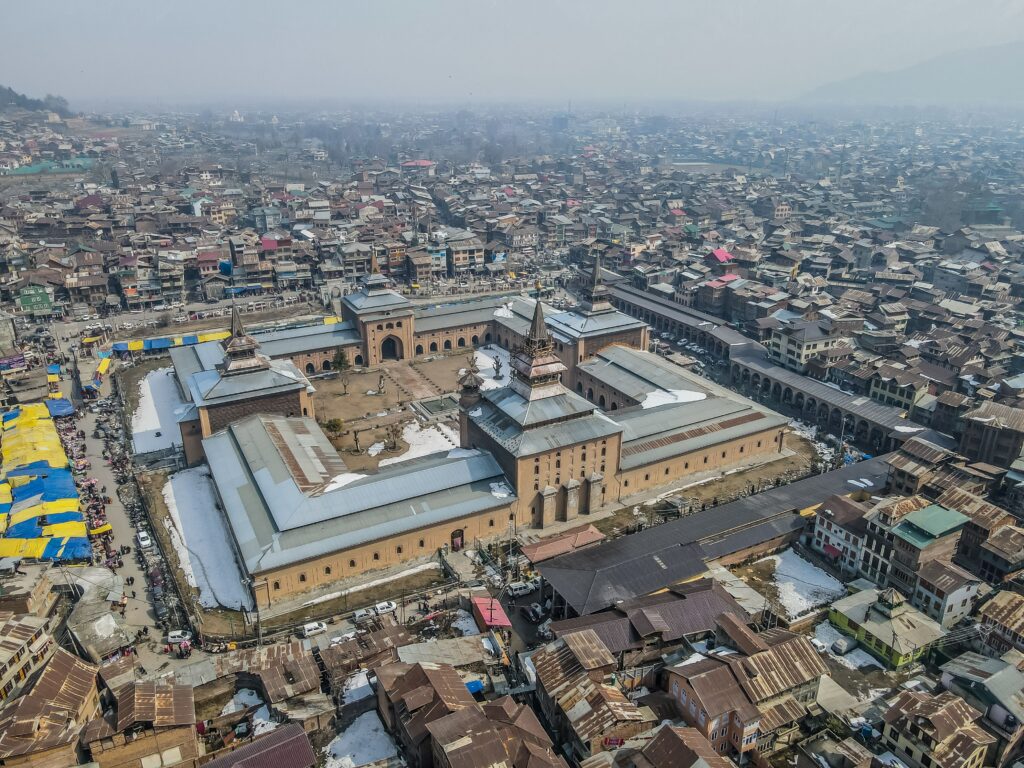
The 3-Hour Srinagar Old City Heritage Tour passes directly through the grand courtyard of Jamia Masjid, making it one of the most visited landmarks in Kashmir’s medieval quarter. Whether you are planning a guided walk or arriving independently, this mosque rewards every traveler with centuries of Kashmiri craftsmanship, living Islamic tradition, and an atmosphere unlike anywhere else in the Himalayas.
At a Glance: Jamia Masjid Srinagar
| Detail | Information |
|---|---|
| Location | Nowhatta Chowk, Old City, Srinagar, J&K 190002 |
| Founded | 1394 CE (Sultan Sikandar Shah Kashmiri) |
| Architectural Style | Indo-Saracenic / Traditional Kashmiri wooden mosque |
| Capacity | Approximately 33,000 worshippers |
| Visiting Hours (Non-Prayer) | Open daily after Fajr; closed during active prayer times |
| Entry Fee | Free for all visitors |
| Best Visiting Window | 08:00 – 11:00 and 14:00 – 16:00 (outside prayer sessions) |
| Friday Status | Major congregational prayers; visitors welcome before and after Jumu’ah |
| Dress Code | Modest clothing; women must cover head; shoes removed at entrance |
| Parking | Paid 30 INR / Hour |
| Photography | Permitted in outer courtyard; respectful discretion inside prayer hall |
History and Significance of Jamia Masjid
Jamia Masjid — literally “the Grand Mosque” — stands at the spiritual heart of Srinagar’s Old City. Sultan Sikandar Shah Kashmiri laid its foundation in 1394 CE, and the mosque has since been rebuilt four times, most completely under the patronage of Emperor Aurangzeb in the seventeenth century. Each reconstruction honoured the original floor plan, a vast open courtyard ringed by colonnaded verandas, while refining the signature Kashmiri aesthetic: dark deodar cedar columns rising without nails, sloping green rooftops, and fine papier-mâché detailing inside the prayer chamber.
Today the mosque functions as the principal Friday mosque of Srinagar, drawing tens of thousands of worshippers for Jumu’ah prayers. Beyond its religious role, it serves as a living museum of Kashmiri craft traditions, as the carved woodwork, calligraphed inscriptions, and handwoven prayer carpets reflect the same artisan vocabulary you will find in the workshops of nearby Maharaj Gunj bazaar.
The mosque holds recognised importance in regional heritage scholarship. UNESCO’s Tentative List for World Heritage Sites has acknowledged the broader cultural landscape of Srinagar, of which Jamia Masjid is one of the anchor monuments.
Architecture: What Makes This Mosque Distinctive
The Deodar Cedar Columns
The prayer hall is supported by 378 individual columns of deodar cedar, each a single trunk hewn from the forests of the Kashmir valley. Unlike South Asian mosques built primarily in brick and lime plaster, this structural reliance on timber gives Jamia Masjid its unmistakably Kashmiri identity. The columns are dark with age, some sealed with generations of oil and incense smoke, and they create a forest-like rhythm as you walk through the interior.
The Central Courtyard
A large open courtyard sits at the centre of the mosque’s rectangular footprint. A chinar tree — sacred in Kashmiri culture — occupies a corner of the yard, its roots predating many of the present structures. The courtyard is paved in dressed stone and provides the main gathering space for overflow worshippers on Fridays. Early in the morning, before the crowds arrive, the courtyard is remarkably still and photogenic.
The Roofline and Finials
Rather than the domes common to Mughal-era mosques, Jamia Masjid Srinagar is topped by distinctly pitched green roofs with gilded finials at each corner pavilion. This silhouette, visible from the lanes of Nowhatta, is one of the most recognisable skyline elements in Old Srinagar and makes an excellent orientation landmark for first-time walkers.
Visiting Hours and Prayer Times in 2026
The mosque is technically accessible throughout the day, but visitors are expected to pause or wait outside during the five daily prayer sessions. In practical terms, the following windows offer the most comfortable and uninterrupted experience for non-worshipping guests:
- Early Morning (08:00 – 09:30): After Fajr prayers conclude, the mosque is calm and beautifully lit. Ideal for photography and quiet exploration.
- Mid-Morning (09:30 – 11:30): The peak visitor window. Tour groups and independent travelers arrive, and local shopkeepers in the surrounding lanes are open for business.
- Early Afternoon (13:00 – 14:00): Avoid this hour on Fridays; it coincides with Jumu’ah. On other days it is relatively quiet.
- Late Afternoon (15:00 – 16:30): Soft golden light enters the courtyard from the west. A good time to sit quietly and observe daily life without crowds.
Prayer times shift by approximately 10–12 minutes each month as the year progresses. In summer months (June–August) the gap between Zuhr and Asr is longer, giving visitors a generous midday window. In winter (December–February) the afternoon window is shorter. Checking a local prayer timetable app or asking your accommodation host each day is strongly advised.
What to Expect Inside
The Entry Process
Remove your shoes at the designated racks beside the main gate on Nowhatta Chowk. Women should have a dupatta or scarf ready to cover their hair before entering. There are no bag searches in 2026, but large backpacks may be left at the shoe rack area. Entry is free of charge with no ticket counter.
The Prayer Hall Interior
The main prayer hall is aligned toward Mecca along its western wall, which is dominated by a carved mihrab (prayer niche) of exceptional detail. The carpet running its full length is replaced periodically and is usually a deep red or burgundy tone. Visitors are welcome to walk along the perimeter of the hall respectfully and observe the mihrab and the calligraphic frieze above it, which contains Quranic inscriptions in black ink on a white plaster ground.
The Atmosphere
Outside Friday prayers, the mosque maintains a contemplative quiet. Local residents come to sit and read, older men converse in the courtyard corners, and children from the neighbourhood pass through on their way to the adjoining lanes. This everyday, lived-in quality is what distinguishes Jamia Masjid from a purely tourist monument — it remains an active community anchor, and visitors who approach it with corresponding respect almost invariably leave with a more genuine impression of Kashmiri Muslim life than any curated exhibition could provide.
Getting to Jamia Masjid from Dal Lake and Central Srinagar
- By auto-rickshaw: From the Tourist Reception Centre or Lal Chowk, ask for Nowhatta Chowk. The ride takes 10–20 minutes depending on traffic and typically costs ₹80–₹120.
- By shikara and on foot: Some visitors reach the Old City by shikara through the city channels, disembarking near Khanyar Ghat and walking 10–15 minutes south to Nowhatta.
- By private taxi: The most comfortable option, especially with luggage or elderly companions. Your driver can wait near the Old City perimeter while you explore.
- On foot from Lal Chowk: A 20–25 minute walk through the bazaar lanes is straightforward if you are comfortable navigating the Old City grid.
Combining Jamia Masjid with the Rest of Old Srinagar
The mosque sits within easy walking distance of several other significant landmarks, and most visitors find a half-day tour the most satisfying way to do the neighbourhood justice. A natural circuit from Nowhatta Chowk moves northeast to the Khanqah-e-Moula (Shah-e-Hamdan shrine) on the bank of the Jhelum, one of the oldest surviving wooden structures in Kashmir. From there you can walk south along the riverfront to the Rozabal shrine, before doubling back through the congested and vibrant lanes of Maharaj Gunj, where wholesale spice, dry fruit, and craft merchants operate from narrow shopfronts as they have for several centuries.
If you prefer a structured introduction to this neighbourhood, the 3-Hour Srinagar Old City Heritage Tour covers exactly this circuit — Jamia Masjid, Khanqah-e-Moula, Rozabal, and both major bazaars — and concludes with a traditional Kashmiri Kahwa tea ceremony and local breads at a neighbourhood chai house. The tour departs daily from Nowhatta Chowk, runs Monday through Sunday from 08:00 to 17:00, and is priced at ₹2,800 per person. It is a practical option for first-time visitors who want cultural context alongside the sights.
Practical Tips for Visiting in 2026
Dress and Behaviour
- Both men and women should wear clothing that covers shoulders and knees as a minimum.
- Women are expected to cover their hair; a lightweight scarf kept in a bag is sufficient.
- Keep voices low inside the prayer hall and courtyard. The mosque is not a social gathering space for visitors.
- Do not walk in front of someone actively praying.
- Mobile phones should be on silent; ringtones are disrespectful and will attract disapproving looks.
Photography
- The outer courtyard, the columns, and the roofline are fair subjects for photography.
- Ask before photographing people; many worshippers, particularly older men and women, prefer not to be photographed.
- Flash photography inside the prayer hall is not appropriate.
- Golden hour — roughly 07:30–09:00 in summer — gives the cedar columns a remarkable warm tone.
What to Bring
- Socks (mandatory; the stone floor is cold in winter and early spring).
- A scarf or shawl for women.
- Cash for nearby bazaar purchases; most Old City shops do not accept digital payments.
- Water; the surrounding lanes have few cafés, though local tea stalls are plentiful.
Accessibility
The main courtyard is at ground level and accessible to wheelchair users, though the surrounding Old City lanes are narrow, uneven, and frequently crowded. Visitors with mobility challenges are best served by a private vehicle that can drop close to the Nowhatta gate, with a companion to assist through the shoe-removal area.
Frequently Asked Questions
Is Jamia Masjid Srinagar open to non-Muslim visitors?
Yes. The mosque welcomes respectful non-Muslim visitors outside active prayer times. There is no formal restriction on entry by religion, provided visitors observe dress and behaviour guidelines.
Is there an entry fee?
No. Entry to Jamia Masjid is entirely free of charge. There are no ticketing counters, no donation boxes at the gate, and no formal registration required.
Can I visit on a Friday?
Yes, but plan your timing carefully. Jumu’ah (Friday congregational prayers) typically takes place around midday and draws large crowds. The mosque is most peacefully visited on Friday mornings before 11:30 or on Friday afternoons after the congregation disperses, usually around 14:00.
How long should I spend at the mosque?
Allow 30–45 minutes for a thorough, unhurried visit. If you plan to sketch, photograph extensively, or simply sit and observe, an hour is comfortable. The mosque works well as one stop in a half-day Old City walk.
Are there any facilities inside?
There are ablution (wuzu) facilities for worshippers on the western side of the complex. Public restrooms for general visitors are not formally provided inside the mosque but are available at nearby spots in the bazaar. Plan accordingly before entering.
What is the best time of year to visit?
Spring (April–May) and autumn (September–October) offer the most pleasant weather for Old City walking. The chinar tree in the courtyard is spectacular in late October when its leaves turn amber and red. Summer visits (June–August) are warm but manageable in the morning hours.
Is the surrounding neighbourhood safe for solo travelers?
Srinagar’s Old City is generally safe and welcoming. Solo travelers — including solo women — regularly explore the bazaars without difficulty. As with any densely populated urban area, standard awareness is sensible. The lanes around Nowhatta are commercially active and populated throughout the day.
Book Your Old City Visit with Expert Support
If you would like personalised advice on visiting Jamia Masjid, arranging a private taxi to the Old City, or booking the guided heritage walk through these historic lanes, the team at Kashmir Tour Packages Taxi is happy to help. Call 9149531004 to speak directly with a local travel specialist who can tailor your Old Srinagar itinerary to your schedule, group size, and interests.
A Final Word
Jamia Masjid Srinagar is one of those rare places that exceeds its own reputation. Photographs capture the geometry of its cedar columns and the scale of its courtyard, but they cannot fully convey the sensory texture of the place — the faint smell of incense, the echo of the call to prayer across the rooftops of Nowhatta, the particular quality of light that filters through the carved wooden lattices on a clear Kashmir morning. Visit early, walk slowly, and let the mosque speak on its own terms. Youwill leave with something that no curated highlight reel can replicate.
Last updated: 2026
Related: 3-hour Old City heritage walking tour that includes Jamia Masjid
Related: nearby Nowhatta bazaar just steps from the mosque
Part of our complete guide: 3-Hour Srinagar Old City Heritage Tour
Book this experience
📋 Get In Touch
Fill in your details — our team will confirm within 2 hours.

I'm Suhail Ahmad, born and raised in Srinagar. In 2022 I founded Kashmir Tour Packages Taxi — a licensed taxi and tour operator registered with the Jammu & Kashmir Tourism Department — because I saw too many visitors arrive in Kashmir with bad information, unreliable drivers, and no idea what was actually worth seeing.
Every article I write comes from personal experience on these routes: the correct season to visit Thajiwas Glacier, the checkpoints you'll cross on the way to Gulmarg, where the road to Betaab Valley gets narrow, what Amarnath Yatra pilgrims actually need to know before they book a taxi. I don't write from Wikipedia. I write from having driven these roads myself, with guests in the back seat.
Our fleet covers Srinagar, Gulmarg, Pahalgam, Sonamarg, Doodhpathri, Yusmarg, Amarnath, and long-haul routes to Leh and Jammu under All India Tourist Vehicle Permits. If something I've written about a route, price, or season seems off — call me directly on +91 9149531004. I answer that number myself.
- J&K Tourism Dept — Registered Tour Operator