
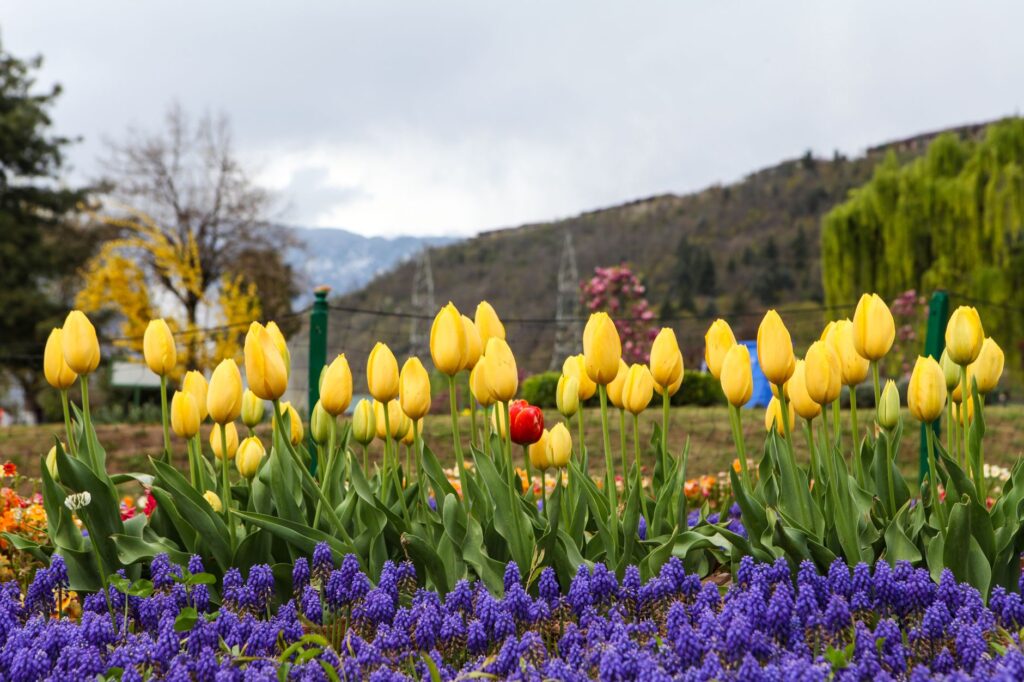
The Tulip Garden in Srinagar Kashmir is the single best reason to time a spring visit to the Valley — and the great news is that three world-class attractions sit within a short drive, making it perfectly practical to combine them all into one unforgettable day. Pari Mahal, Nishat Bagh, and Dal Lake are all clustered along the same scenic corridor, so you lose almost no travel time moving between them.
What Is the Tulip Garden in Srinagar Kashmir?
The Indira Gandhi Memorial Tulip Garden is Asia’s largest tulip garden, spread across 30 terraced hectares on the lower slopes of the Zabarwan Range. It overlooks Dal Lake from a dramatic elevation, giving every photograph a natural backdrop that most botanical gardens can only dream of. More than 1.5 million tulips representing over 68 distinct varieties erupt in colour every spring, transforming the hillside into stacked ribbons of red, yellow, violet, white, and deep burgundy.
The garden operates on a strictly seasonal schedule, opening only during the annual Tulip Festival. For the 2027 season, the garden is expected to open on 16 March 2027 and remain open through 19 April 2027, following its established historical pattern. If you are planning a trip in 2026, keep an eye on the official J&K Floriculture Department announcements for the confirmed schedule, since bloom timing can shift slightly depending on how the winter ends.
Gates open at 9:00 AM and close at 7:00 PM seven days a week during the festival. Most visitors find that two hours inside the garden is a comfortable and satisfying visit — enough time to walk every terrace, find the best viewpoints over Dal Lake, and take all the photos you want.
Ticket Prices and How to Book
Admission is kept deliberately affordable so that the garden is accessible to everyone. Current ticket prices are:
| Visitor Category | Entry Fee |
|---|---|
| Indian Adult | ₹100 |
| Indian Child (Under 12) | ₹50 |
| Foreign National | ₹400 |
| Professional Camera Fee | ₹150 |
Tickets can be purchased in two ways:
- Online: Book in advance through the official J&K Floriculture Department portal at floriculture.jk.gov.in. Online booking is strongly recommended during the first two weeks of April, when footfall is at its peak and queues at the gate can be long.
- Offline: Purchase directly at the ticket window on arrival. Come early — by 10:00 AM on weekends during peak bloom, lines can stretch considerably.
If you carry a DSLR or any professional-grade camera equipment, remember to pay the ₹150 professional camera fee at the ticket counter. Smartphone cameras are covered by the standard entry ticket.
When to Visit for Peak Bloom
The garden is beautiful from the moment it opens, but the absolute visual peak falls during the first two weeks of April. During this window, the greatest number of varieties are simultaneously in full bloom, the colour contrast between terraces is most dramatic, and the mountain backdrop is still dusted with snow, creating a contrast that is almost surreal. If you can choose your travel dates freely, aim for the first ten days of April.
Visiting on a weekday morning is the single best practical tip anyone can offer. Crowds build significantly on weekends and public holidays, particularly after 11:00 AM. Arriving right at the 9:00 AM opening gives you perhaps 90 minutes of relatively uncrowded pathways before tour groups arrive in volume.
Nearby Attraction 1 — Pari Mahal (The Palace of Fairies)
Perched on a ridge above the Cheshma Shahi gardens, Pari Mahal is a Mughal-era monument that most visitors overlook in favour of the more famous Mughal gardens lower down. That oversight is very much their loss. Built by Dara Shikoh, the scholarly son of Emperor Shah Jahan, in the seventeenth century, the terraced arched ruins were originally used as a library and observatory for the study of astronomy and astrology.
The structure itself is striking — six terraces of crumbling but carefully preserved arched chambers, framed by formal gardens planted with roses and seasonal flowers. The real reward, however, is the panoramic view from the uppermost terrace. On a clear April morning, you look out over the entire Dal Lake basin, with Srinagar spread across the valley floor and the Pir Panjal range filling the horizon. It is one of the finest viewpoints in the entire city, and it is almost never as crowded as the lakeside gardens.
Pari Mahal sits roughly 2 kilometres from the Tulip Garden, making it a natural first or last stop on a combined day itinerary. The drive takes under ten minutes, and the short uphill walk through the entrance gardens is pleasant rather than strenuous. Plan around 45 minutes to an hour for a relaxed visit.
For more background on the historical significance of this site, the Archaeological Survey of India maintains records of Mughal heritage monuments across the subcontinent, including the broader Srinagar complex.
Nearby Attraction 2 — Nishat Bagh (Garden of Bliss)
Nishat Bagh is the largest of Srinagar’s classical Mughal gardens and sits directly on the eastern shore of Dal Lake, roughly 11 kilometres from the city centre. It was laid out in 1633 by Asif Khan, the brother of Empress Noor Jahan, and its design follows the classic charbagh template — a central water channel running from mountain spring to lake, flanked by twelve terraces that represent the twelve signs of the zodiac.
What makes Nishat Bagh particularly rewarding in spring is the combination of mature chenar (oriental plane) trees, flowering beds, and an unobstructed view of the Zabarwan hills behind and Dal Lake in front. The long central channel reflects the sky and the tree canopy, creating the kind of composed, symmetrical beauty that Mughal garden designers intended. During April, the flowerbeds are at their most colourful, which dovetails beautifully with a Tulip Garden visit on the same day.
Entry is managed by the J&K Tourism Department and is nominal. The garden is spacious enough that even on busy days you can find quiet corners. Allow at least an hour, more if you enjoy a leisurely pace or want to sit by the lake shore at the garden’s lower boundary.
Practical Note on Garden Sequence
If you are combining the Tulip Garden and Nishat Bagh in a single day, a sensible sequence is to start at Nishat Bagh early (it also opens at 9:00 AM), then move to the Tulip Garden by mid-morning when your Nishat Bagh visit wraps up, and finish at Pari Mahal in the early afternoon when the light on the ruins is particularly warm. This order minimises backtracking along the Cheshma Shahi Road corridor.
Nearby Attraction 3 — Dal Lake
Dal Lake needs no extended introduction — it is the emblem of Kashmir, the body of water whose imagery has defined how the rest of the world pictures the Valley for generations. What is worth stressing for visitors combining it with a Tulip Garden day is that Dal Lake is not a single experience but a menu of them, and the time of day shapes which one you choose.
In the early morning, the famous floating vegetable market assembles on the lake’s inner channels, with growers paddling their shikaras laden with lotus roots, leafy greens, and spring produce to trade with buyers before the city wakes. This requires being on the water by 6:00 AM, which is before the Tulip Garden opens — making it a natural pre-garden activity if you are staying on a houseboat.
During the day, a shikara ride across the main lake body, weaving through the floating gardens known as raads and past the houseboats moored along Boulevard Road, takes between one and two hours depending on how far you go and how willing your boatman is to stop for photographs. The classic shikara ride remains one of the most distinctive experiences in Indian tourism and pairs naturally with an afternoon finish after the Tulip Garden.
In the evening, the lake takes on a golden quality as the sun drops behind the western hills. Watching the light change from the Boulevard promenade, or from a shikara anchored near the middle of the lake, is a fitting end to a day spent among spring blooms and Mughal monuments.
A Suggested One-Day Itinerary
Here is a practical framework for combining all four experiences in a single full day, starting with an optional early-morning activity and finishing at the lake:
- 6:00 AM (optional) — Floating vegetable market on Dal Lake by shikara. Arrange through your houseboat host or a registered shikara operator the evening before.
- 9:00 AM — Nishat Bagh opens. Arrive early for uncrowded pathways and good morning light on the chenar trees. Allow 60–75 minutes.
- 10:30 AM — Drive to the Tulip Garden (approximately 4 kilometres from Nishat Bagh). Enter by 11:00 AM. Allow two hours for a thorough visit of all terraces.
- 1:00 PM — Lunch. Several dhabas and small restaurants operate near the garden entrance on Cheshma Shahi Road during the festival season. Alternatively, your driver can take you to Boulevard Road where a wider range of options is available.
- 2:30 PM — Drive up to Pari Mahal (roughly 10 minutes from the Tulip Garden). Allow 45–60 minutes to explore the terraces and enjoy the elevated view.
- 4:00 PM — Return to Dal Lake Boulevard for a late-afternoon shikara ride. The light is particularly beautiful between 4:00 PM and 6:00 PM in April.
- 6:00 PM onwards — Dinner at one of the lakeside restaurants or, if you are staying on a houseboat, return for a home-cooked Kashmiri meal on board.
Getting Between the Attractions
All four destinations lie along a single logical route hugging the eastern shore of Dal Lake and climbing slightly into the Zabarwan foothills. The total road distance between Nishat Bagh (the farthest point) and Pari Mahal (the highest point) is no more than 7 kilometres. With a dedicated taxi or cab, movement between stops is seamless — you do not need to worry about bus schedules or auto-rickshaw availability during the festival rush.
Having a private cab for the day is genuinely the most comfortable and time-efficient way to manage this itinerary. Your driver can park, wait, advise on current road conditions, and handle the logistics so that you focus entirely on enjoying what you are seeing. During the Tulip Festival, parking near the garden entrance fills up quickly after 10:00 AM, so a local driver who knows the area makes a noticeable difference.
Practical Tips Before You Go
- Wear comfortable, grip-friendly footwear. The Tulip Garden’s terraces and Pari Mahal’s pathways both involve uneven stone surfaces. Sandals are not ideal.
- Bring a light layer. Mornings in early April in Srinagar can be cool, particularly at the elevation of Pari Mahal. By afternoon the temperature is typically pleasant, but the morning chill is real.
- Carry cash. While online ticket booking is available for the Tulip Garden, shikara operators and many small vendors around Pari Mahal and Nishat Bagh prefer cash. ATMs on Boulevard Road are reliable.
- Book your taxi in advance during April. The Tulip Festival period is one of the busiest weeks of the Kashmir tourism calendar. Drivers are booked out quickly, and last-minute hires can be expensive or unavailable.
- Photography light is best in the morning. The Tulip Garden faces roughly west, so morning light falls cleanly across the terraces. By mid-afternoon, the hillside creates shade on the lower terraces.
- Check the official garden status before your visit. The garden’s opening date is tied to natural bloom conditions and can vary by a few days. The official source is the J&K Floriculture Department portal linked in the ticket booking section above.
Where to Stay for Easy Access
Staying on a houseboat on Dal Lake puts you within a short shikara ride or a five-minute drive of the Tulip Garden, Nishat Bagh, and Pari Mahal. It is the most atmospheric option by a significant margin, and waking up on the lake on an April morning — with the Zabarwan Range reflected in still water — is an experience that stands on its own merit.
If you prefer a conventional hotel, the Boulevard Road properties give similar proximity. The city centre and older parts of Srinagar are a 20–30 minute drive from the garden cluster, which is manageable but adds to total travel time on a packed day.
Book Your Kashmir Tulip Package
Planning a trip to see the Tulip Garden in Srinagar Kashmir alongside Pari Mahal, Nishat Bagh, and Dal Lake is best done with local expertise on your side, particularly if you want to coordinate timing around peak bloom. Kashmir Tour Packages Taxi offers dedicated Tulip Special packages that take the planning pressure off you entirely — from airport transfers and accommodation to guided garden visits and shikara arrangements.
To book a package or ask any question about visiting Kashmir in spring, call Kashmir Tour Packages Taxi at 9149531004. The team is available to advise on the best dates based on current bloom forecasts, suggest itinerary adjustments for your group size, and arrange reliable, comfortable private transportation for everything described in this article.
Frequently Asked Questions
How far is Nishat Bagh from the Tulip Garden?
Nishat Bagh is approximately 4 kilometres from the Indira Gandhi Memorial Tulip Garden along Cheshma Shahi Road. By taxi the drive takes around 10 minutes under normal traffic conditions. During the Tulip Festival, morning traffic can add a few minutes, but it is still a very manageable short hop.
Can I walk between Pari Mahal, Nishat Bagh, and the Tulip Garden?
Walking between Nishat Bagh and the Tulip Garden is possible in theory — the road distance is around 4 kilometres — but it is not recommended during peak festival season. The road has limited pedestrian infrastructure, traffic moves quickly, and April temperatures by mid-morning make a roadside walk uncomfortable. A taxi or auto-rickshaw between stops is the practical choice for almost all visitors.
Pari Mahal involves a short uphill walk from the car park to the monument itself, but that internal walk is straightforward and takes under ten minutes at a relaxed pace.
Is the Tulip Garden suitable for young children?
Yes, very much so. The terraced pathways are wide and mostly paved, making navigation with young children straightforward. Children under 12 enter at the reduced price of ₹50. The garden’s visual spectacle — the sheer scale and colour — tends to delight children who might otherwise find historical monuments less engaging. Combine it with a shikara ride on Dal Lake in the afternoon and you have a genuinely memorable family day.
What are the Tulip Garden’s opening hours?
The garden opens at 9:00 AM and closes at 7:00 PM every day during the festival season. Last entry is typically 30 minutes before closing. Arriving at or shortly after opening is strongly recommended, both for smaller crowds and for the best photographic light on the terraces.
Do I need to book Tulip Garden tickets in advance?
Advance online booking is not mandatory but is strongly advised during the first two weeks of April, which mark peak bloom and the highest visitor numbers of the season. You can book online through the official portal at floriculture.jk.gov.in. Walk-in tickets are sold at the gate ticket window, but queues can be lengthy on weekends and public holidays.
Is Pari Mahal worth visiting alongside the Tulip Garden?
Absolutely. Pari Mahal is one of Srinagar’s most underrated heritage sites, and because it draws fewer crowds than the Mughal gardens below, visiting it on the same day as the Tulip Garden gives you a pleasing contrast — the vibrant, colour-saturated energy of the tulip terraces followed by the quiet, contemplative atmosphere of the ruined palace and its sweeping valley view. Most visitors spend 45 minutes to an hour there and consistently rate it as a highlight of their day.
When does the Tulip Garden open for the 2027 season?
The Indira Gandhi Memorial Tulip Garden is expected to open on 16 March 2027 and remain open through 19 April 2027. The peak bloom window falls during the first two weeks of April. Exact dates are confirmed by the J&K Floriculture Department closer to the season, so check the official booking portal for the most current information before finalising your travel plans.
What is the best way to get around all four attractions in one day?
A private taxi booked for the full day is comfortably the best option. It gives you complete flexibility over timing, eliminates waiting for shared transport during the busy festival period, and allows your driver to suggest adjustments based on real-time conditions — such as steering you to a quieter entrance lane or advising when a particular spot is less crowded. Pre-booking through a reliable local operator like Kashmir Tour Packages Taxi ensures you have a vehicle and driver confirmed well before you arrive.
Last updated: 2026
Related: Tulip Garden Srinagar main guide
Related: getting to Tulip Garden and nearby sites
Related: Kashmir tour package covering Tulip Garden and Nishat Bagh
Related: taxi service covering Tulip Garden and nearby attractions
Part of our complete guide: Best Tulip Garden Taxi Service Srinagar: 7 Reasons to Book Now
Book this experience
📋 Get In Touch
Fill in your details — our team will confirm within 2 hours.

I'm Suhail Ahmad, born and raised in Srinagar. In 2022 I founded Kashmir Tour Packages Taxi — a licensed taxi and tour operator registered with the Jammu & Kashmir Tourism Department — because I saw too many visitors arrive in Kashmir with bad information, unreliable drivers, and no idea what was actually worth seeing.
Every article I write comes from personal experience on these routes: the correct season to visit Thajiwas Glacier, the checkpoints you'll cross on the way to Gulmarg, where the road to Betaab Valley gets narrow, what Amarnath Yatra pilgrims actually need to know before they book a taxi. I don't write from Wikipedia. I write from having driven these roads myself, with guests in the back seat.
Our fleet covers Srinagar, Gulmarg, Pahalgam, Sonamarg, Doodhpathri, Yusmarg, Amarnath, and long-haul routes to Leh and Jammu under All India Tourist Vehicle Permits. If something I've written about a route, price, or season seems off — call me directly on +91 9149531004. I answer that number myself.
- J&K Tourism Dept — Registered Tour Operator