
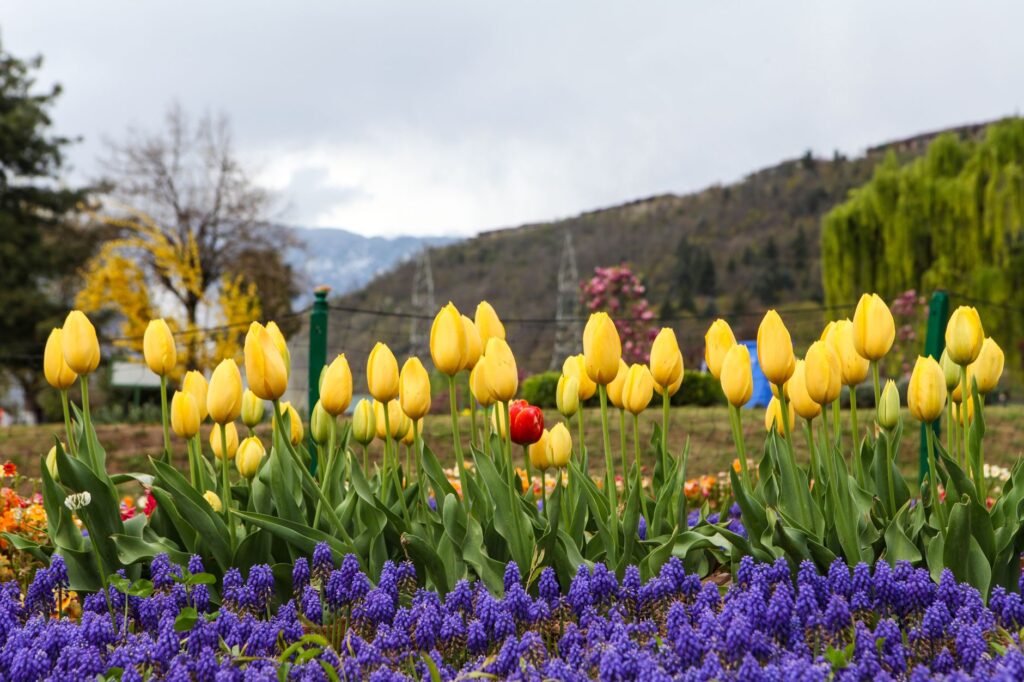
The Tulip Garden in Srinagar Kashmir is one of Asia’s most photographically rewarding destinations, drawing travel photographers, content creators, and casual visitors alike during its brief spring bloom. Knowing the right shooting spots, lighting windows, and the ₹150 professional camera fee policy before you arrive will save you time and help you return home with genuinely memorable images.
What Is the Indira Gandhi Memorial Tulip Garden?
Spread across 30 terraced hectares on the foothills of the Zabarwan Range, the Indira Gandhi Memorial Tulip Garden is officially Asia’s largest tulip garden. It overlooks the shimmering expanse of Dal Lake, with the snow-dusted peaks of the Pir Panjal range visible on clear mornings behind the blooms. Each spring, more than 1.5 million tulips across over 68 varieties erupt in layered bands of crimson, violet, salmon, yellow, and white — a colour palette that is simply unmatched anywhere else on the subcontinent.
The garden sits on Cheshma Shahi Road, Srinagar, and is managed by the Floriculture Department of Jammu & Kashmir. It opens exclusively during the annual Tulip Festival season — typically running from late March through mid-April — and closes once the blooms begin to fade. Visiting or photographing it requires planning your Kashmir trip around this narrow seasonal window.
Peak Bloom Window: When to Arrive for the Best Shots
The garden’s peak bloom window falls in the first two weeks of April. During this period the maximum number of varieties are simultaneously open, the terrace colours are at their most saturated, and the overall visual impact is at its highest. Arrive even a week late and you risk finding that the earlier, lower-altitude terraces have already passed their prime.
A few timing notes worth keeping in mind:
- Early April mornings — the first hour after opening at 9:00 AM offers the softest, most directional light before the Srinagar sun climbs overhead and bleaches the colours.
- Late afternoons (4:00 PM–6:30 PM) — the golden hour before the 7:00 PM closing time bathes the terraces in warm amber light that makes reds and oranges particularly vivid. This is widely considered the single best window for landscape photography inside the garden.
- Overcast days — a thin cloud cover acts like a giant softbox, eliminating harsh shadows inside the flower beds and producing even, saturated tones ideal for macro and close-up work.
- Weekday mornings — crowd density is significantly lower, making it easier to frame clean foreground-to-background compositions without waiting for people to move.
For the 2027 season, the garden is expected to open around 16 March 2027 and run through approximately 19 April 2027, following the historical pattern established by the Floriculture Department. If you are planning travel well in advance, target the first two weeks of April 2027 for peak conditions.
Ticket Prices and the ₹150 Professional Camera Fee
Understanding the fee structure before you arrive prevents surprises at the gate. The garden operates both an online booking portal and a conventional ticket window for offline purchase.
| Category | Entry Fee |
|---|---|
| Indian Adult | ₹100 |
| Indian Child (Under 12) | ₹50 |
| Foreign National | ₹400 |
| Professional Camera | ₹150 |
The ₹150 professional camera fee applies to DSLRs, mirrorless camera systems, and other dedicated camera equipment carried into the garden. Smartphone cameras are not charged this additional fee. The fee is payable at the ticket counter alongside your entry ticket, so budget for it separately if you are bringing a camera bag. You can book tickets online in advance at the official Floriculture Department portal: floriculture.jk.gov.in — doing so during peak season is strongly recommended since the garden can reach its visitor cap quickly on high-traffic days.
Garden hours are 9:00 AM to 7:00 PM, seven days a week during the festival season.
Drone Rules and Aerial Photography
Drone photography at the Tulip Garden is a subject that confuses many visitors, so clarity here is important. As of 2026, recreational drone flights over the garden and the surrounding Zabarwan foothills require prior permission from the Directorate General of Civil Aviation (DGCA) through the Digital Sky platform. Srinagar falls within a controlled airspace zone, and the Tulip Garden’s proximity to residential and heritage areas adds further regulatory scrutiny.
Key points for drone photographers:
- Obtain a valid Unique Identification Number (UIN) for your drone before travelling.
- Apply for a flight permission on the Digital Sky portal well in advance — approval can take several days.
- Coordinate with local authorities on arrival; the garden’s security staff and the district administration may have additional seasonal restrictions during the festival period.
- Nano drones (under 250 g) face fewer restrictions but are still subject to airspace rules in Srinagar.
- Flying without permission risks equipment confiscation and a fine. Do not rely on anecdotal advice from other travellers — always verify current regulations directly.
The garden’s elevated terraces, particularly the upper tier, offer naturally dramatic elevated perspectives even from ground level that rival many drone compositions — so a wide-angle lens from the top terrace remains an excellent alternative when aerial permits are impractical to arrange.
Best Photography Spots Inside the Tulip Garden in Srinagar Kashmir
The garden is divided into terraced sections that climb the Zabarwan hillside. Each section presents a distinct photographic character. Familiarising yourself with the layout before entering lets you move purposefully rather than wandering.
1. The Upper Terraces — Mountain-and-Bloom Compositions
From the highest accessible terrace, you can frame the descending rows of tulips with Dal Lake glittering in the middle distance and the Zabarwan or Pir Panjal peaks providing a white backdrop. A telephoto lens (70–200 mm range) is ideal here for compressing the layers and bringing the mountains visually closer to the flowers. Shoot in the first hour after opening before haze builds.
2. The Central Terrace Paths — Leading Lines and Colour Blocks
The manicured walkways running between massed flower beds create natural leading lines that draw a viewer’s eye through the frame. A 24–70 mm lens shot at f/8–f/11 from a low angle captures the sense of being surrounded by colour on both sides. Late afternoon light coming from the west gives these paths particularly warm, long shadows.
3. Lower Garden — Close-Up and Macro Work
The lower terraces tend to bloom first and are also where the most densely planted single-colour blocks appear. Bring a dedicated macro lens or a close-focus prime (50 mm or 100 mm macro) to capture individual tulip cups, dewdrops on petals in the early morning, and the delicate vein patterns inside the flowers. Overcast mornings here are genuinely spectacular.
4. The Entry Gate Arch — Iconic Framing Shot
The ornamental gate at the garden entrance, with the flower terraces visible beyond it, is a classic framing device. Arrive just before 9:00 AM opening time, position yourself outside, and shoot inward as the gates open to capture the garden in its undisturbed early-morning state before crowds accumulate.
5. Dal Lake Overlap Viewpoints
From specific elevated positions along the garden’s outer boundary path, you can compose shots that place a band of tulips in the foreground with Dal Lake filling the mid-ground and the old city skyline or Shankaracharya Hill temple in the distance. A polarising filter here significantly reduces lake glare and deepens the sky.
Essential Gear Checklist for Tulip Garden Photography
- Wide-angle lens (16–35 mm) — for dramatic terrace-wide environmental shots
- Standard zoom (24–70 mm) — the workhorse lens for most situations inside the garden
- Telephoto (70–200 mm) — for compressing mountain-bloom compositions from the upper terrace
- Macro lens (100 mm) — essential for close-up flower detail work
- Circular polarising filter — reduces glare on Dal Lake and deepens sky blues
- ND filter (3-stop or 6-stop) — useful for long-exposure crowd-clearing or silky water shots of nearby Dal Lake
- Extra batteries — cold Srinagar mornings drain batteries faster than you expect
- Lightweight tripod or gorilla pod — for low-light morning shots and macro stability
- Waterproof bag cover — spring weather in Kashmir can change quickly
- Knee pads or a small kneeling pad — getting low for flower-level angles is far more comfortable with one
Nearby Photography Locations to Combine with Your Visit
A morning in the Tulip Garden pairs naturally with several nearby locations that extend your shooting day and provide contrasting subjects and landscapes.
Nishat Bagh
Located just a short drive along the Dal Lake shore, Nishat Bagh is a Mughal terraced garden with mature chinar trees, geometric water channels, and lake-facing pavilions. Its structured formality contrasts beautifully with the riot of tulip colour and offers excellent architectural and water-reflection photography opportunities.
Dal Lake
The lake itself — a ten to fifteen minute drive from the Tulip Garden — offers shikara (wooden boat) reflections at dawn and dusk, floating market scenes in early morning, and wide panoramic views of the Zabarwan Range mirrored in still water. A shikara ride during the golden hour after the garden closes provides a completely different and rewarding photographic perspective.
Pari Mahal
This ruined seven-terraced Mughal garden perched on the Zabarwan hillside above the main gardens offers sweeping elevated views over Dal Lake and the Srinagar valley. Early evening light from Pari Mahal, with the city spread below you, produces compelling landscape shots that round out a full day of varied photography.
Practical Tips for a Smooth Shoot
- Book your entry ticket online in advance at the official portal, especially if visiting during peak bloom in early April. Gate queues can be long and the daily visitor cap has historically been reached on busy days.
- Arrive at opening time (9:00 AM) on your first visit to assess the layout with soft light and fewer crowds, then return in the late afternoon on a subsequent day for golden-hour shooting.
- Wear muted, neutral clothing if you intend to be in your own photographs — bright colours will compete with the flowers for visual attention.
- Stay on the marked paths — stepping into the flower beds for angles is prohibited and damages the plantings. Garden staff enforce this strictly during festival season.
- Carry snacks and water — the garden’s internal refreshment options are limited and queues at the small stalls can be long.
- Check weather forecasts using the India Meteorological Department’s official forecast portal before each shooting day. A thin overcast day is often better for photography than a harsh cloudless afternoon.
- Allow at least two hours inside — the official estimated visit duration is two hours, but photographers routinely need three to four to work through the full terrace sequence methodically.
Getting to the Tulip Garden from Srinagar City
The garden is located on Cheshma Shahi Road, Srinagar — approximately 11 kilometres from Lal Chowk in the city centre. The most practical options for reaching it during festival season are:
- Private taxi — the most convenient option, especially if you are carrying camera gear. A dedicated taxi lets you time your arrival precisely for the right light.
- Auto-rickshaw — available from the city centre, though less comfortable for bulky camera bags.
- Hotel pickup — most Srinagar hotels and houseboats can arrange morning garden transfers; confirm the night before.
Parking near the garden becomes congested quickly on busy festival days, so a drop-off arrangement with your driver — who waits or returns at a scheduled time — is far more efficient than driving yourself.
Book Your Kashmir Tulip Trip with Expert Local Support
Planning a photography-focused Kashmir trip around the Tulip Festival requires precise timing, reliable ground transport, and accommodation that positions you well for early-morning and late-afternoon shoots. The team at Kashmir Tour Packages Taxi specialises in exactly this kind of tailored Kashmir travel. Whether you need a Tulip Special Package that builds your entire itinerary around peak bloom timing, or simply a dependable taxi service for daily garden runs, call 9149531004 to speak directly with the team, ask specific questions about current garden conditions, and lock in arrangements before the festival season fills up.
Frequently Asked Questions
Is there a separate fee for professional cameras at the Tulip Garden?
Yes. A professional camera fee of ₹150 is charged per camera at the entry gate, in addition to your standard entry ticket. This applies to DSLRs and mirrorless systems. Smartphones are not subject to this fee.
What are the garden’s opening hours?
The Indira Gandhi Memorial Tulip Garden is open from 9:00 AM to 7:00 PM daily during its seasonal operation window.
When is the best time of day to photograph the tulips?
Early morning (9:00–10:30 AM) for soft directional light and low crowds, and late afternoon (4:00–6:30 PM) for warm golden-hour tones. Overcast mornings are excellent formacro and close-up work due to even, shadow-free light.
Can I fly a drone inside the Tulip Garden?
Drone flights require prior DGCA permission through the Digital Sky platform. Srinagar is a controlled airspace zone, and additional seasonal restrictions may apply during the festival. Always obtain the necessary permissions before travelling rather than relying on informal advice.
What is the peak bloom window?
The first two weeks of April represent the peak bloom window, when the maximum number of varieties are simultaneously open and the terrace colours are at their most vivid and saturated.
Can I book tickets online?
Yes. Online booking is available through the official Floriculture Department portal at floriculture.jk.gov.in. Tickets can also be purchased at the offline ticket window at the garden entrance. Online booking is strongly recommended during peak season to avoid long queues and potential sell-outs on high-traffic days.
How much time should I budget inside the garden?
The official estimated visit duration is two hours, but photographers and content creators typically need three to four hours to work through the full terrace sequence, experiment with different lenses and angles, and wait for optimal light conditions at specific spots.
What entry fees apply to foreign nationals?
Foreign nationals pay ₹400 per person for entry, compared to ₹100 for Indian adults and ₹50 for Indian children under twelve years of age.
Which nearby attractions can I combine with a Tulip Garden visit?
Nishat Bagh, Dal Lake, and Pari Mahal are all within easy reach and offer contrasting photographic subjects — Mughal garden architecture, shikara reflections, and elevated valley panoramas respectively — making them natural companions to a tulip shoot on the same day or across consecutive days.
What should I wear for photography inside the garden?
Wear muted, neutral tones if you plan to appear in your own photographs. Bright clothing competes visually with the tulip colours and can distract from the subject. Comfortable walking shoes are essential given the sloped terrace paths, and a light waterproof layer is advisable given Kashmir’s changeable spring weather.
Is the garden open every day during the season?
Yes. The Tulip Garden operates seven days a week — Monday through Sunday — throughout its seasonal window, from 9:00 AM to 7:00 PM each day.
Last updated: 2026. Entry fees, camera charges, and seasonal dates are confirmed for the current operational season. Always verify the official opening date for a future season directly with the Floriculture Department of Jammu & Kashmir before finalising travel arrangements.
Related: Tulip Garden Srinagar visitor overview
Related: best bloom timing for Tulip Garden photography
Related: buy your Tulip Garden entry and camera fee ticket
Related: photograph Nishat Bagh and Dal Lake nearby
Part of our complete guide: Best Tulip Garden Taxi Service Srinagar: 7 Reasons to Book Now
Book this experience
📋 Get In Touch
Fill in your details — our team will confirm within 2 hours.

I'm Suhail Ahmad, born and raised in Srinagar. In 2022 I founded Kashmir Tour Packages Taxi — a licensed taxi and tour operator registered with the Jammu & Kashmir Tourism Department — because I saw too many visitors arrive in Kashmir with bad information, unreliable drivers, and no idea what was actually worth seeing.
Every article I write comes from personal experience on these routes: the correct season to visit Thajiwas Glacier, the checkpoints you'll cross on the way to Gulmarg, where the road to Betaab Valley gets narrow, what Amarnath Yatra pilgrims actually need to know before they book a taxi. I don't write from Wikipedia. I write from having driven these roads myself, with guests in the back seat.
Our fleet covers Srinagar, Gulmarg, Pahalgam, Sonamarg, Doodhpathri, Yusmarg, Amarnath, and long-haul routes to Leh and Jammu under All India Tourist Vehicle Permits. If something I've written about a route, price, or season seems off — call me directly on +91 9149531004. I answer that number myself.
- J&K Tourism Dept — Registered Tour Operator