
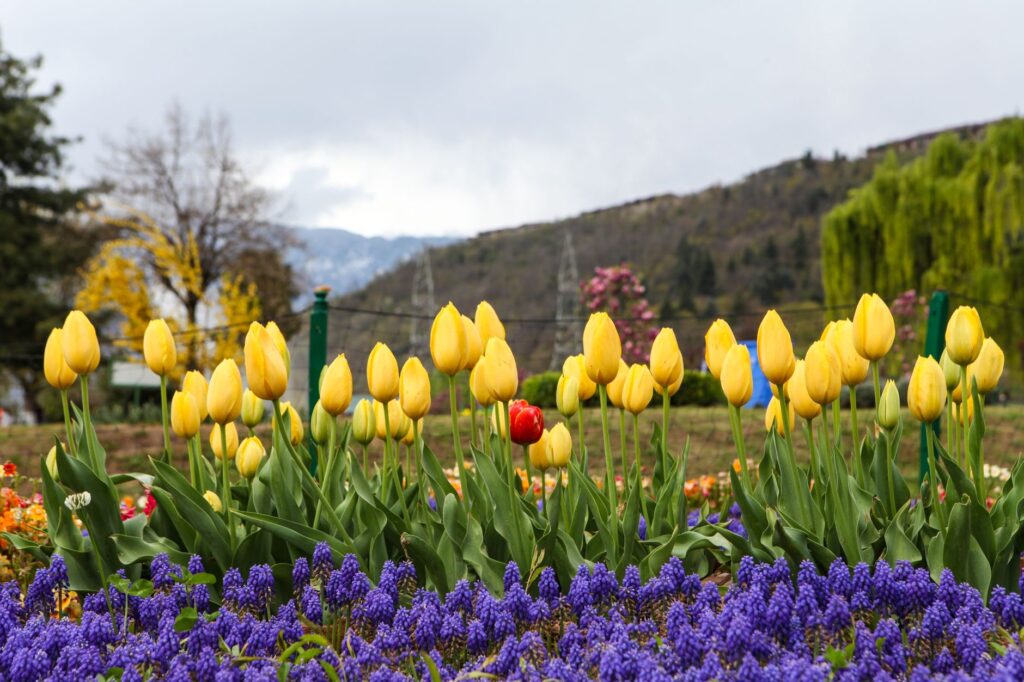
The Tulip Garden in Srinagar Kashmir is Asia’s largest tulip garden, drawing hundreds of thousands of visitors each spring to witness over 1.5 million blooms cascading down the foothills of the Zabarwan Range. If you are planning a Kashmir trip and want to experience the garden at its most spectacular, this complete guide covers everything you need — timings, ticket prices, bloom windows, travel tips, and how to get there.
What Is the Indira Gandhi Memorial Tulip Garden?
Officially named the Indira Gandhi Memorial Tulip Garden, this breathtaking floral landmark sits on Cheshma Shahi Road in Srinagar, Jammu & Kashmir, at the coordinates 34.1147°N, 74.8878°E. Spread across 30 hectares on terraced hillside slopes, the garden offers an unobstructed panoramic view of the iconic Dal Lake below — a combination of natural scenery and horticultural achievement that is almost impossible to find anywhere else in South Asia.
The garden was developed under the Floriculture Department of the Jammu & Kashmir government with the twin goals of promoting floriculture in the region and boosting tourism during the spring season. It hosts more than 68 distinct tulip varieties in an extraordinary palette of red, yellow, purple, white, orange, pink, and bicolor blooms. Beyond tulips, the garden also features hyacinths, daffodils, ranunculus, and other spring flowers, making it a comprehensive floral experience rather than a single-species showcase.
With over 17,655 visitor reviews and an average rating of 4.5 out of 5, the garden consistently ranks among the top-rated attractions in Kashmir. It is a centerpiece of the annual Kashmir Tulip Festival, a state-sponsored event that celebrates spring and Kashmiri culture simultaneously.
At a Glance: Key Facts About the Tulip Garden in Srinagar Kashmir
| Detail | Information |
|---|---|
| Official Name | Indira Gandhi Memorial Tulip Garden |
| Location | Cheshma Shahi Road, Srinagar, J&K – 190001 |
| Area | 30 Hectares |
| Total Tulip Varieties | 68+ |
| Total Blooms | Over 1.5 Million |
| Opening Time | 9:00 AM |
| Closing Time | 7:00 PM |
| Days Open | Monday through Sunday (all week) |
| Peak Bloom Window | First two weeks of April |
| Availability | Seasonal (late March to mid-April) |
| Average Visit Duration | 2 Hours |
| Visitor Rating | 4.5 / 5 (17,655 reviews) |
Ticket Prices and Entry Fees
Entry to the Indira Gandhi Memorial Tulip Garden is priced affordably to encourage broad public access. The fee structure is straightforward, with separate rates for Indian nationals, children, and foreign visitors.
| Category | Entry Fee |
|---|---|
| Indian Adult | ₹100 |
| Indian Child (Under 12) | ₹50 |
| Foreign National | ₹400 |
| Professional Camera Fee | ₹150 |
The professional camera fee of ₹150 applies to DSLRs and professional-grade equipment. Smartphone photography is generally included within the standard entry ticket. Videography with dedicated video cameras may attract an additional charge at the discretion of on-duty staff, so it is worth confirming at the ticket window upon arrival.
How to Book Tickets Online
The J&K Floriculture Department operates an official online ticketing portal, which allows you to book and pay for your entry in advance. This is particularly useful during the peak bloom period when queues at physical ticket windows can be long. You can book your tickets online through the official J&K Floriculture Department e-ticket portal.
If you prefer to pay on the day, tickets are available at the Ticket Window at the garden entrance. Arrive early during the peak season — ideally before 10:00 AM — to avoid the longest queues, which tend to build between 11:00 AM and 2:00 PM.
Best Time to Visit the Tulip Garden in Srinagar Kashmir
Timing your visit correctly is the single most important factor in having a memorable experience. The garden is a strictly seasonal attraction, open only during the spring bloom period, which typically runs from late March to mid-April each year.
Peak Bloom Window
The first two weeks of April represent the peak bloom window, when the overwhelming majority of the 68+ tulip varieties are simultaneously in full flower. During these two weeks, the entire 30-hectare terraced slope is a continuous carpet of color — an experience that photographs simply cannot fully capture. If you have any flexibility in your travel dates, targeting the first to the fourteenth of April will give you the best odds of seeing the garden at its most spectacular.
Early Season vs. Late Season
Visiting in the last week of March means some of the early-blooming varieties will already be open, while later-blooming cultivars are still in bud. The garden still looks beautiful, and crowds are noticeably thinner. Conversely, visiting after mid-April means you may catch the tail end of the blooms, with petals beginning to drop from many plants. Late-season visitors still see plenty of color, but the pristine, layered carpet effect diminishes as the season closes.
2027 Season Dates
The Indira Gandhi Memorial Tulip Garden is expected to open for the 2027 season on 16 March 2027 and remain open through 19 April 2027, following the historical pattern of opening in late March. Plan your Kashmir trip around these dates to ensure you do not miss the garden entirely.
Best Time of Day
Early morning visits — arriving at or just after the 9:00 AM opening — offer the softest light for photography, cooler temperatures, and the thinnest crowds. Late afternoon light between 4:00 PM and 6:00 PM also produces beautiful, golden-toned photographs. Midday, particularly on weekends, is the busiest period and should be avoided if possible.
Layout and Terraces: How the Garden Is Organized
The garden is laid out across multiple terraces that descend the hillside in broad, sweeping steps. Each terrace is planted with blocks of complementary colors, so the visual effect when viewed from a higher terrace is one of a living mosaic stretching downward toward Dal Lake. Pathways run along each terrace level, allowing visitors to walk alongside the blooms at eye level and then ascend or descend via connecting stairways.
The uppermost terraces sit closest to the Zabarwan Range foothills and offer the broadest views of the garden as a whole, as well as unobstructed sightlines across Dal Lake. Many photographers gravitate to the upper levels for wide-angle compositions that include both the blooms and the lake in the same frame.
The lower terraces tend to be more densely planted and offer closer, more intimate encounters with individual varieties. Informational plaques throughout the garden identify the name and origin of each tulip cultivar, which is particularly interesting for horticulture enthusiasts.
Other Flowers in the Garden
While tulips dominate the visual experience, the garden also features:
- Hyacinths — intensely fragrant clusters in purple, white, and pink
- Daffodils — classic yellow and white varieties lining pathway borders
- Ranunculus — layered, rose-like blooms in vibrant oranges and reds
- Muscari (Grape Hyacinth) — low-growing blue-purple ground cover
- Flowering cherry and almond trees providing a canopy backdrop
The combination of fragrances — particularly from the hyacinths — adds an olfactory dimension to the visit that makes the experience genuinely immersive.
How to Get to the Tulip Garden in Srinagar
The garden is located on Cheshma Shahi Road, Srinagar, roughly 11 kilometers from the city center. Several transport options are available depending on your preference and budget.
By Taxi or Private Car
A private taxi or cab from Lal Chowk or the main hotel areas of Srinagar is the most convenient and comfortable option. The journey takes approximately 25–40 minutes depending on traffic, which can be significant during the peak festival period. Booking a dedicated Kashmir tour taxi ensures you have a reliable vehicle waiting for you at the gate when you are ready to leave — particularly important on busy days when ride-hailing apps can have surge pricing or low availability.
By Auto-Rickshaw
Auto-rickshaws are available from the main tourist areas and offer a cheaper alternative to taxis. Negotiate the fare before boarding, and keep in mind that during the festival season, auto-rickshaw drivers are well aware that demand is high.
By Shikara and Road Combination
Some visitors staying on Dal Lake houseboats combine a shikara ride on the lake with a short taxi journey to the garden, enjoying Dal Lake views from the water before exploring the garden’s views of Dal Lake from above — a satisfying loop.
Nearby Sightseeing: Making the Most of Your Day
The Tulip Garden is located in one of Srinagar’s most scenic corridors, surrounded by other major Mughal-era and heritage attractions. Combining the garden with one or two nearby sites makes for a full and rewarding day out.
Nishat Bagh
Just a short drive from the Tulip Garden, Nishat Bagh is one of the most celebrated Mughal gardens in Kashmir, laid out in the seventeenth century along twelve terraces descending to the eastern shore of Dal Lake. Its mature chinar trees, geometric flower beds, and cascading water channels offer a dramatically different but equally beautiful experience. Visiting Nishat Bagh and the Tulip Garden on the same day is a very popular itinerary combination.
Pari Mahal
Pari Mahal, the “Palace of Fairies,” is an ancient seven-terraced garden and ruin perched on a hilltop overlooking Dal Lake, roughly 2 kilometers from the Tulip Garden. The sunset views from Pari Mahal across the entire vale of Kashmir are extraordinary, making it an ideal final stop to round off a day that began at the Tulip Garden.
Dal Lake
Dal Lake itself, visible from the garden terraces, is a natural extension of any Tulip Garden visit. An evening shikara ride on the lake, watching the Zabarwan foothills (and the Tulip Garden’s hillside) reflect in the water as the light fades, is one of the quintessential Kashmir experiences.
Photography Tips for the Tulip Garden
The garden is a photographer’s dream, but a few practical tips will help you come away with images that do it justice.
- Arrive at opening time (9:00 AM) for soft morning light and minimal crowd interference in wide shots.
- Use the upper terraces for sweeping landscapes that incorporate the lake — a standard wide-angle or 24–35mm lens works well here.
- Get low for close-up shots — crouching to ground level with a macro lens or telephoto compression produces striking individual bloom portraits.
- Overcast days are ideal — high clouds diffuse harsh sunlight and prevent blown-out whites on light-colored tulips.
- Bring a professional camera? Pay the ₹150 fee at the ticket window. It is a minor cost for unrestricted shooting access.
- Drone photography is regulated — always check current J&K drone regulations and obtain necessary permissions well in advance, as restrictions in this region can be strict.
- Use the garden’s color blocks as natural compositional frames — a row of red tulips flanking a path of yellow ones creates natural leading lines.
Practical Tips and Visitor Advice
What to Wear
Srinagar in late March and early April can be pleasantly warm during midday but cool — sometimes cold — in the early morning and after sunset. Layering is the most practical approach: a light base layer, a mid-layer sweater or fleece, and a windproof outer shell will keep you comfortable from the 9:00 AM opening through a late afternoon visit. Comfortable walking shoes with good grip are essential, as the terraced pathways can be uneven and occasionally wet from morning dew or light rain.
What to Bring
- Valid photo ID for ticket purchase (required for foreign nationals; advisable for all visitors)
- Water bottle — the garden is large and you will be on your feet for the full 2-hour average visit
- Sunscreen and sunglasses for midday visits
- Small snacks — food vendors are available near the entrance but options inside the garden itself are limited
- A light rain jacket — spring showers in Srinagar are common and can arrive with little warning
- Cash for the ticket window if not booking online; ATMs near the garden can have queues during festival season
Accessibility
The terraced layout means the garden involvessignificant walking and stair climbing. Visitors with mobility limitations may find some sections challenging. The lower terraces near the entrance are more accessible, and much of the visual splendor can be appreciated from the first few terrace levels without ascending to the very top. It is advisable to contact the Floriculture Department directly before your visit if you have specific accessibility requirements.
Facilities at the Garden
- Clean restrooms are available near the main entrance and at intervals within the garden
- A small food and beverage kiosk operates near the entrance gate during the season
- Security staff and garden attendants are present throughout to assist visitors
- First aid is available at the main gate
- Designated seating areas are placed along the terrace pathways for rest stops
Crowd Management Tips
The festival period, particularly weekends between April 1 and April 14, can see extremely high footfall. To manage the experience effectively:
- Visit on a weekday if your schedule permits — crowds are substantially thinner Monday through Thursday
- Book tickets online in advance to skip the entry queue entirely
- Arrive at opening time or in the late afternoon (after 4:30 PM) when the bulk of day-trippers have departed
- Consider hiring a local guide who knows the garden’s layout and can take you directly to the best viewing points and least congested pathways
The Kashmir Tulip Festival: Culture Beyond the Blooms
The Indira Gandhi Memorial Tulip Garden serves as the focal venue for the annual Kashmir Tulip Festival, organized by the Jammu & Kashmir government’s Department of Floriculture. The festival is one of the most significant events on the Kashmir cultural calendar and has grown substantially in national and international profile over recent years.
Beyond the floral displays, the festival typically features live Kashmiri folk music and dance performances, handicraft exhibitions showcasing the region’s celebrated pashmina weaving, papier-mâché work, and walnut wood carving, as well as food stalls offering traditional Wazwan dishes and Kashmiri kahwa tea. The combination of visual spectacle, cultural programming, and culinary experience makes the festival a genuinely multi-sensory event rather than simply a garden visit.
For up-to-date information on festival programming, official dates, and event schedules, the Jammu & Kashmir Tourism Department’s official website publishes confirmed details each season. It is worth bookmarking and checking in February or early March to align your travel plans with the official opening announcement.
History of the Tulip Garden in Srinagar Kashmir
The garden was established in 2007 under the initiative of the Jammu & Kashmir government, with the primary aim of promoting floriculture as an economic activity in the region and transforming Kashmir’s spring tourism season into a globally recognized event. The choice of location — the terraced foothills of the Zabarwan Range overlooking Dal Lake — was deliberate and inspired by the Mughal garden tradition of using natural topography to create layered, visually dramatic landscapes.
The garden was named in honor of former Prime Minister Indira Gandhi, reflecting her government’s focus on horticulture development programs across India during the 1970s and 1980s. Since its inaugural season, the garden has expanded both in area and in the number of tulip bulbs planted annually, growing from a regional attraction into Asia’s largest tulip garden — a designation that has helped put Kashmir on the international spring tourism map alongside traditional destinations like the Netherlands’ Keukenhof.
The annual import and planting of bulbs is a significant horticultural operation. Bulbs are sourced internationally, including from the Netherlands — the global center of tulip cultivation — and acclimated to Kashmir’s specific soil and climate conditions. The Zabarwan foothills’ elevation, cool temperatures, and well-drained soil make the site exceptionally well-suited to tulip cultivation, mirroring in many ways the alpine conditions in which tulips thrive naturally.
Comparing the Tulip Garden to Other Srinagar Gardens
Srinagar is famous for its historic Mughal gardens, and a natural question for visitors is how the Tulip Garden compares to classics like Shalimar Bagh, Nishat Bagh, and Chashme Shahi.
| Garden | Best Feature | Best Season | Floral Focus |
|---|---|---|---|
| Indira Gandhi Tulip Garden | Scale, mass blooms, lake views | Late March – mid-April | Tulips, spring bulbs |
| Nishat Bagh | Mughal terraces, chinar trees | Spring and autumn | Mixed seasonal flowers |
| Shalimar Bagh | Historical grandeur, water channels | Spring and autumn | Roses, chinars |
| Chashme Shahi | Natural spring water, compact charm | Spring | Roses, ornamental shrubs |
| Pari Mahal | Hilltop ruins, panoramic views | Year-round | Terrace lawns and flowers |
The Tulip Garden is unrivaled for sheer floral impact during its brief seasonal window. The Mughal gardens, by contrast, offer a longer visiting season and a stronger sense of historical architecture. Ideally, a Kashmir itinerary of five days or more can comfortably include all of these gardens, experiencing each for what it uniquely offers.
Suggested Itinerary: Tulip Garden Day Trip
If you are planning a single focused day around the Tulip Garden, the following schedule makes excellent use of the day’s light and energy:
- 8:30 AM — Depart your hotel or houseboat by taxi toward Cheshma Shahi Road
- 9:00 AM — Arrive at opening time, collect pre-booked tickets or purchase at window, enter the garden
- 9:00 AM – 11:00 AM — Explore the garden thoroughly, ascending all terraces; morning light is ideal for photography
- 11:15 AM — Drive to Nishat Bagh (10 minutes by car) for a contrast visit to the Mughal garden
- 12:30 PM — Lunch at a restaurant on the Dal Lake boulevard or return to your houseboat
- 2:30 PM — Rest during the hottest and busiest midday period
- 4:00 PM — Drive to Pari Mahal for late afternoon and sunset views across the vale
- 6:30 PM — Return to Dal Lake for an evening shikara ride as the light fades over the Zabarwan hills
This itinerary covers the three key nearby sightseeing spots — the Tulip Garden, Nishat Bagh, and Pari Mahal — while also incorporating a Dal Lake experience, giving you a full and well-rounded Kashmir spring day.
Booking a Kashmir Tour Package Around the Tulip Festival
Visiting the Tulip Garden as a standalone day trip is rewarding, but the most memorable experiences typically come from building a complete Kashmir itinerary around the festival window. A well-planned tour package can include houseboat accommodation on Dal Lake, guided visits to the Mughal gardens, Gulmarg day trips for snow and skiing, Pahalgam valley excursions, local market walks in the old city, and of course, a dedicated Tulip Garden morning during the peak bloom window.
Tour packages specifically designed around the Tulip Festival are available and represent excellent value, as accommodation and transport are pre-arranged during a period when both are in high demand. You can explore Kashmir Tulip Special Packages to find itineraries that place the garden visit at the heart of a broader Kashmir experience.
Frequently Asked Questions
Is the Tulip Garden open all year?
No. The Indira Gandhi Memorial Tulip Garden is a strictly seasonal attraction, open only during the spring bloom period — typically late March to mid-April each year. Outside this window the garden is closed to the public. For the 2027 season, it is expected to open on 16 March 2027 and close on 19 April 2027.
What is the entry fee for the Tulip Garden in Srinagar?
Indian adult tickets are priced at ₹100, Indian children under 12 pay ₹50, and foreign nationals pay ₹400. A professional camera fee of ₹150 applies if you are bringing a DSLR or professional-grade equipment into the garden.
When is the best time to visit the Tulip Garden?
The first two weeks of April represent the peak bloom window when the maximum number of varieties are simultaneously in full flower. For the lightest crowds on any given day, arrive at the 9:00 AM opening time or visit on a weekday.
How long does a visit to the Tulip Garden take?
The average visit duration is approximately 2 hours, which is enough time to walk all the terraces, photograph the key views, and explore the variety plaques at a comfortable pace. Photography enthusiasts and garden lovers may wish to allow 3 hours.
Can I book tickets online for the Tulip Garden?
Yes. Tickets can be booked in advance through the official J&K Floriculture Department e-ticket portal. Walk-in tickets are also available at the Ticket Window at the entrance gate on the day of your visit.
Is the Tulip Garden suitable for children?
Yes, it is a very family-friendly attraction. Children under 12 enjoy a reduced entry fee of ₹50. The open terraces and vibrant colors make it engaging for younger visitors, though parents should be mindful of the stairways between terraces and keep an eye on children near the edges of terrace walls.
Are there restaurants or food stalls inside the garden?
A small food and beverage kiosk operates near the entrance during the season. The garden itself does not have a full restaurant. For a proper meal, the Dal Lake boulevard has numerous restaurants and cafes within a short drive.
What other gardens are near the Tulip Garden?
The three nearest sightseeing spots are Nishat Bagh, Pari Mahal, and Dal Lake, all within 10–15 minutes by car. Shalimar Bagh and Chashme Shahi are also reachable within 20–30 minutes and make natural companion visits on the same day or the following day.
Is the garden accessible for visitors with mobility limitations?
The terraced layout involves stairs and uneven pathways, which can be challenging for visitors with limited mobility. The lower terraces near the entrance are more accessible and still offer beautiful views. Contacting the Floriculture Department in advance is recommended for visitors who need specific assistance.
Plan Your Kashmir Tulip Garden Visit With Expert Help
Planning a trip around the Tulip Festival requires careful timing, reliable transport, and ideally, accommodation booked well in advance of the peak season. The team at Kashmir Tour Packages Taxi specializes in exactly this kind of planning — from airport pickups and houseboat bookings to dedicated garden tour days with experienced local drivers who know the best routes and timings. Whether you are visiting for a weekend or a full week, they can tailor an itinerary that ensures you see the Tulip Garden at its best without the stress of managing logistics yourself. Call 9149531004 today to discuss your requirements, ask any questions, or make a booking.
Last Updated: 2026
Related: best time to visit the Tulip Garden in Srinagar
Related: how to book Tulip Garden Srinagar tickets
Related: how to reach the Tulip Garden Srinagar
Related: Tulip Garden Srinagar photography tips
Related: nearby attractions around Tulip Garden Srinagar
Related: Kashmir Tulip Garden tour packages 2026
Related: visiting Tulip Garden Srinagar with family
Related: book a taxi to Tulip Garden Srinagar
Part of our complete guide: Best Tulip Garden Taxi Service Srinagar: 7 Reasons to Book Now
Book this experience
📋 Get In Touch
Fill in your details — our team will confirm within 2 hours.

I'm Suhail Ahmad, born and raised in Srinagar. In 2022 I founded Kashmir Tour Packages Taxi — a licensed taxi and tour operator registered with the Jammu & Kashmir Tourism Department — because I saw too many visitors arrive in Kashmir with bad information, unreliable drivers, and no idea what was actually worth seeing.
Every article I write comes from personal experience on these routes: the correct season to visit Thajiwas Glacier, the checkpoints you'll cross on the way to Gulmarg, where the road to Betaab Valley gets narrow, what Amarnath Yatra pilgrims actually need to know before they book a taxi. I don't write from Wikipedia. I write from having driven these roads myself, with guests in the back seat.
Our fleet covers Srinagar, Gulmarg, Pahalgam, Sonamarg, Doodhpathri, Yusmarg, Amarnath, and long-haul routes to Leh and Jammu under All India Tourist Vehicle Permits. If something I've written about a route, price, or season seems off — call me directly on +91 9149531004. I answer that number myself.
- J&K Tourism Dept — Registered Tour Operator