
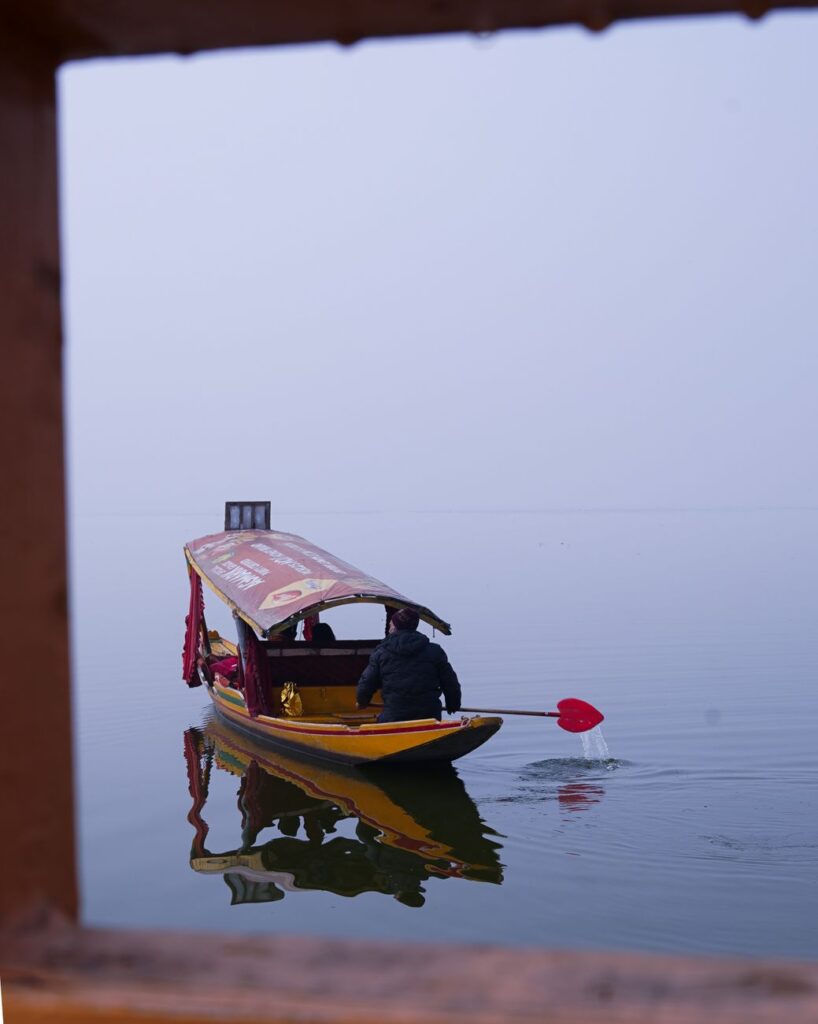
A Shikara ride in Dal Lake is the single most iconic thing you can do in Srinagar, and in 2026 it remains as magical as ever. Gliding across still water on a hand-carved wooden boat, with the Himalayas reflected around you and floating gardens drifting past, this one- to two-hour experience distills everything Kashmir is famous for into a single unforgettable journey.
What Is a Shikara Ride In Dal Lake?
A Shikara is a flat-bottomed, canopied wooden boat that has been the lifeblood of Dal Lake for centuries. Paddled by skilled local boatmen, Shikaras ferry locals across the lake, carry fresh vegetables from the floating gardens to the market, and — most visibly for visitors — offer leisurely sightseeing tours across one of the most photogenic bodies of water in Asia.
Dal Lake sits at an elevation of roughly 1,583 metres above sea level in the heart of Srinagar, Jammu & Kashmir. Spread across approximately 18 square kilometres, it is flanked by the Zabarwan mountain range on one side and the old city on the other. The lake is divided into four interconnected basins — Gagribal, Lokut Dal, Bod Dal, and Nagin — and a single Shikara ride can carry you through several of them, past bobbing houseboats, lotus beds, and the famous floating vegetable markets that open before dawn.
At-a-Glance Facts: Shikara Ride in Dal Lake
| Detail | Information |
|---|---|
| Starting Point | Jetty No. 9, Dal Lake, Srinagar |
| 1-Hour Fare | ₹700 per boat |
| 2-Hour Fare | ₹1,500 per boat |
| Currency | INR |
| Operating Days | Monday through Sunday (all week) |
| Operating Hours | 06:00 – 18:00 |
| Availability | Seasonally available |
| Ride Duration Options | 1 hour or 2 hours |
| Rating | 5 / 5 (based on 1,500 reviews) |
| Coordinates | 34.1218° N, 74.8776° E |
Shikara Ride Prices and Duration Options
The official government-regulated fares in 2026 make a Shikara ride one of the most affordable luxury experiences in India. Prices are per boat, not per person, so couples and small families get exceptional value.
- 1-Hour Ride — ₹700: Perfect for first-time visitors or anyone short on time. In sixty minutes your boatman will take you past the signature cluster of houseboats, through a narrow water channel lined with weeping willows, and out toward the open expanse of Bod Dal where you can see the snow-capped peaks most clearly.
- 2-Hour Ride — ₹1,500: The recommended option for anyone who wants a richer experience. The extra time allows a detour to the floating vegetable and flower market, a slow circuit around one of the small lake islands, and a drift through the lotus garden area that is stunning from May through August.
Tips for the boatman are customary and warmly received. A tip of ₹100–₹200 for a standard ride is considered generous and fair.
Comparing the 1-Hour vs 2-Hour Ride: Which Should You Choose?
Both options offer the essential Dal Lake experience, but the right choice depends on your itinerary and what you want to see.
| Feature | 1-Hour Ride (₹700) | 2-Hour Ride (₹1,500) |
|---|---|---|
| Houseboat views | ✓ | ✓ |
| Himalayan panorama | ✓ | ✓ |
| Floating gardens visit | Partial | ✓ Full |
| Lotus beds area | ✗ | ✓ |
| Floating market detour | ✗ | ✓ (early morning start) |
| Sunset photography time | Limited | Comfortable |
| Best for | Day-trippers, tight schedules | Honeymooners, photographers, relaxed travellers |
If budget is the only constraint, consider this: the difference between the two options is just ₹800. For most visitors who have travelled hundreds or thousands of kilometres to reach Srinagar, spending an extra ₹800 to double the time on one of the world’s most beautiful lakes is an easy decision.
What You Will See on Your Shikara Ride
Floating Gardens (Rad)
Known locally as rad, these are man-made islands of vegetation anchored to the lakebed with long bamboo poles. Kashmiri farmers have cultivated them for generations, growing tomatoes, cucumbers, melons, and lotus roots. Floating past them at sunrise, when the mist is still on the water and the farmers are already at work, is a genuinely humbling sight.
Houseboats
Dal Lake is home to over a thousand elaborately carved wooden houseboats, many dating back to the colonial era when British officers who were not permitted to own land in Kashmir built permanent floating homes instead. Today they range from budget guesthouses to luxuriously appointed heritage properties. Seeing them from the water — especially at dusk when their interiors glow — is far more atmospheric than any photograph suggests.
Char Chinar Island
One of the most photographed spots on the lake, this small island holds four ancient Chinar trees (hence the name, char meaning four). The trees turn a fiery amber and crimson in autumn, making October one of the most popular months for the 2-hour ride that can circle the island.
The Floating Vegetable Market
Operating between 05:00 and 07:00, the floating market is only reachable on a 2-hour ride that departs at opening time (06:00). Dozens of vendors in small Shikaras cluster together on the water, trading produce, exchanging news, and bargaining loudly — all while their boats bump gently against each other in the early morning light. It is chaotic, colourful, and completely unlike anything else in India.
Nehru Park and Nagin Lake
Longer rides can extend toward Nagin Lake — sometimes called the “Jewel in the Ring” of Dal — and pass by Nehru Park, a small island garden maintained by the local municipality. Both are calm, green, and far less crowded than the main shoreline near the Boulevard.
Best Time for a Shikara Ride in Dal Lake
The lake is open for Shikara rides from roughly March through November, with peak season running from May through September. Each period has a distinct character:
- March – April (Spring): Cherry blossoms and almond flowers surround the lake. The air is crisp and clear, visibility is excellent, and crowds have not yet peaked. Highly recommended for photography.
- May – June (Early Summer): Lotus buds begin to open, the weather is warm and pleasant, and the floating gardens are at their most productive. This is the busiest tourist season.
- July – August (Monsoon-Adjacent): The Kashmir Valley receives far less rainfall than the rest of India during the monsoon. The lake is full, green, and lush. Morning mist creates extraordinary photographic conditions.
- September – October (Autumn): The Chinar trees turn gold and red around the lake. Crowd levels drop, temperatures are comfortable, and the landscape is arguably at its most dramatic.
- November – February (Winter): Parts of Dal Lake can freeze over in deep winter. Rides may be limited or unavailable. Check seasonal availability before booking.
Best time of day: Sunrise (06:00–08:00) for the floating market and mist photography; late afternoon (15:00–17:00) for golden-hour light on the Himalayas and the houseboats. Both experiences are strikingly different and equally worthwhile.
How to Reach Jetty No. 9, Dal Lake
The main departure point for tourist Shikara rides is Jetty No. 9 on the Dal Lake Boulevard, Srinagar. The Boulevard (officially Maulana Azad Road) runs along the northeastern shore of the lake and is easy to find from any hotel in the city.
- From Srinagar Airport: Approximately 14–18 km depending on traffic. By taxi, the journey takes 30–45 minutes. A pre-booked airport cab is the most reliable option.
- From Lal Chowk (city centre): Around 3–4 km. Auto-rickshaws and shared cabs run frequently along the Boulevard route.
- Parking: Limited roadside parking is available near the jetties. If you are driving yourself, arrive before 09:00 on peak-season days to secure a spot.
Practical Tips for a Better Shikara Ride Experience
- Book a government-licensed boatman: Look for the official licence displayed on the boat. Licensed boatmen operate under regulated fares and are accountable to the tourism authority. The J&K Tourism Department maintains a register of licensed operators, details of which can be found on the official J&K Tourism website.
- Negotiate in advance: Agree on the duration and price before you board. The fares listed (₹700 for 1 hour, ₹1,500 for 2 hours) are the regulated government rates; any quoted price significantly above these warrants a conversation.
- Wear layers: Even in summer, being on open water in the early morning can be surprisingly cool. A light jacket is useful before 09:00.
- Bring sunscreen and sunglasses: Water reflects UV radiation. The glare off Dal Lake in mid-morning is intense even on overcast days.
- Keep your camera accessible: Photographic opportunities appear suddenly — a kingfisher landing, a vendor’s colourful boat, a reflection perfectly aligned with the mountains. A camera bag buried in a rucksack will cost you shots.
- Politely decline vendor boats: Floating vendors selling saffron, papier-mâché crafts, jewellery, and soft drinks will approach your Shikara during the ride. There is no obligation to buy, and a polite shake of the head is respected. That said, Kashmiri saffron purchased directly from a lake vendor is often genuine and competitively priced.
- Combine with a houseboat stay: The experience of a Shikara ride is amplified tenfold if you are also staying on a houseboat. Your houseboat host can typically arrange a private Shikara for sunrise and sunset at rates similar to the jetty prices.
Shikara Ride as Part of a Kashmir Tour Package
Most well-structured Kashmir tour packages include at least one complimentary or included Shikara ride as part of the Srinagar sightseeing day. If you are booking a 5-night or 7-night Kashmir package, confirm with your operator whether the ride is included or needs to be booked separately.
Standalone visitors and those on self-planned itineraries can simply walk to Jetty No. 9 and negotiate directly with the boatmen on any day within operating hours. No advance booking is typically required for a standard 1-hour or 2-hour ride, though during peak season (June–August) a small queue is common in the 07:00–10:00 window. Arriving at opening time (06:00) eliminates the wait entirely and rewards you with the best light.
For travellers combining a Shikara ride with other activities — Gulmarg day trips, Pahalgam valley excursions, or the Mughal Gardens circuit — a private taxi from Kashmir Tour Packages Taxi ensures you reach the lake jetty at the right time without relying on shared transport schedules.
Frequently Asked Questions
Is a Shikara ride safe for children and elderly passengers?
Yes. Shikaras are stable, wide-bottomed boats with comfortable cushioned seating and a protective canopy. Life jackets are available on request and should be worn by young children. The boats do not travel fast and the lake, while large, is calm in most weather conditions. Elderly visitors and those with limited mobility find the low boarding step manageable at most jetties.
How many people can fit in one Shikara?
A standard tourist Shikara comfortably seats four to six adults. Larger group Shikaras can accommodate up to eight passengers. The price quoted (₹700 / ₹1,500) is per boat, not per person, making it very economical for families and couples.
Can I take a Shikara ride in winter?
Seasonal availability applies. In mild winters (December–early February), rides are often possible on the parts of the lake that remain unfrozen, but full-route rides may not be available. It is advisable to check current conditions with local operators or the J&K Tourism Department before planning a winter visit specifically for a Shikara ride.
Are there night Shikara rides available?
Official operatinghours are 06:00–18:00. Night rides on the open lake are not part of the regulated tourist programme. Some houseboat operators arrange private evening Shikara rides for their guests that conclude before dark, which is a worthwhile alternative for experiencing the lake at sunset without exceeding safety guidelines.
What should I wear for a Shikara ride?
Comfortable, casual clothing is appropriate. Avoid very loose or flowing garments that could catch on the boat’s fittings. Closed-toe shoes or sandals with a back strap are safer than flip-flops when boarding and disembarking. A hat or cap, sunglasses, and a light jacket (especially for early morning rides) complete the ideal outfit.
Is photography allowed during the ride?
Absolutely, and it is one of the primary reasons most visitors take the ride. There are no restrictions on personal photography. Drone photography over the lake is subject to local civil aviation authority rules and requires prior permission; check the latest DGCA Digital Sky portal regulations before flying any unmanned aerial vehicle over Dal Lake.
Can I combine a Shikara ride with a visit to the floating market?
Yes, but only on a 2-hour ride that departs at 06:00 sharp. The floating vegetable and flower market winds down by 07:00–07:30, so timing is critical. Ask your boatman specifically to include the market in the route when you negotiate the ride at the jetty the evening before or first thing in the morning.
What Visitors Say About the Shikara Ride in Dal Lake
With over 1,500 reviews and a perfect 5-out-of-5 rating, the Shikara ride at Dal Lake consistently ranks as the most praised activity across Kashmir tourism platforms. The themes that appear most consistently in visitor feedback include the extraordinary sense of calm the ride produces, the warmth and local knowledge of the boatmen, the sheer scale and beauty of the Himalayan backdrop, and the feeling of stepping into a landscape that looks exactly like — or better than — every photograph they had ever seen of Kashmir. Honeymooners in particular cite the Shikara ride as the defining memory of their Kashmir trip, often ahead of Gulmarg’s snow or Pahalgam’s meadows.
Book Your Shikara Ride with Kashmir Tour Packages Taxi
Ready to glide across the most beautiful lake in India? Call Kashmir Tour Packages Taxi at 9149531004 to book your Shikara ride, arrange airport pickup, or plan a complete Kashmir itinerary that includes Dal Lake, Gulmarg, Pahalgam, and beyond. The team is available seven days a week and can answer questions about seasonal conditions, best departure times, and how to combine the Shikara experience with other sightseeing in Srinagar. Whether you are travelling as a couple, a family, or a solo explorer, a quick call is all it takes to put the perfect Kashmir day together.
About This Listing
This information is provided by Kashmir Tour Packages Taxi, a Srinagar-based operator specialising in Kashmir travel, taxi services, and curated tour packages. Fare details, operating hours, and availability reflect conditions as of 2026 and are based on government-regulated tourism rates for Dal Lake Shikara rides. All prices are in Indian Rupees (INR) and are per boat unless otherwise stated. For the most current seasonal availability, visitors are encouraged to confirm directly with the operator or check the Jammu & Kashmir Tourism Department before travel.
Last updated: 2026
Book this experience
📋 Get In Touch
Fill in your details — our team will confirm within 2 hours.

I'm Suhail Ahmad, born and raised in Srinagar. In 2022 I founded Kashmir Tour Packages Taxi — a licensed taxi and tour operator registered with the Jammu & Kashmir Tourism Department — because I saw too many visitors arrive in Kashmir with bad information, unreliable drivers, and no idea what was actually worth seeing.
Every article I write comes from personal experience on these routes: the correct season to visit Thajiwas Glacier, the checkpoints you'll cross on the way to Gulmarg, where the road to Betaab Valley gets narrow, what Amarnath Yatra pilgrims actually need to know before they book a taxi. I don't write from Wikipedia. I write from having driven these roads myself, with guests in the back seat.
Our fleet covers Srinagar, Gulmarg, Pahalgam, Sonamarg, Doodhpathri, Yusmarg, Amarnath, and long-haul routes to Leh and Jammu under All India Tourist Vehicle Permits. If something I've written about a route, price, or season seems off — call me directly on +91 9149531004. I answer that number myself.
- J&K Tourism Dept — Registered Tour Operator