
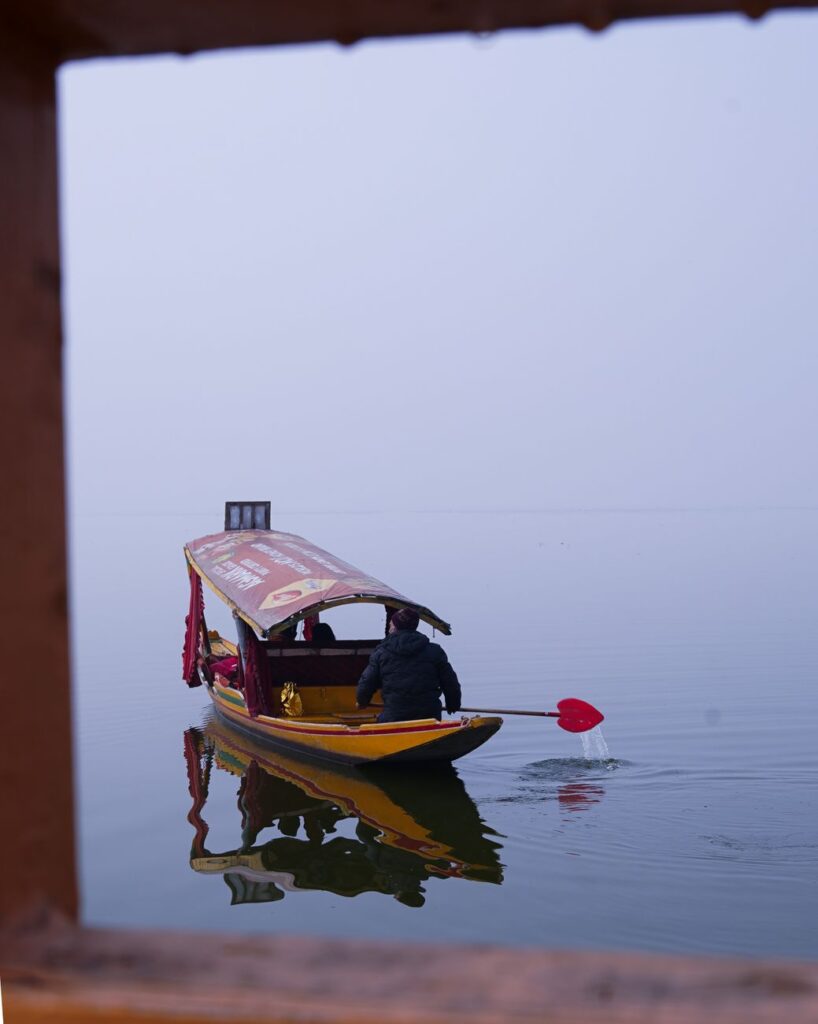
A Shikara ride in Dal Lake is one of the most iconic experiences in all of Kashmir — a gentle glide across mirror-still waters aboard a traditional wooden boat, surrounded by the snow-capped Himalayas, floating gardens, and the timeless charm of Srinagar’s houseboat culture. It is available daily from 06:00 to 18:00, starting at just ₹700 for one hour.
What Is a Shikara Ride In Dal Lake?
Dal Lake is the jewel of Srinagar, sprawling across approximately 18 square kilometres in the heart of the Kashmir Valley. A Shikara is a flat-bottomed, hand-crafted wooden boat — elegant, narrow, and decorated with fringed canopies and cushioned seats — that has been the primary mode of transport on Dal Lake for centuries. Fishermen, flower sellers, vegetable vendors, and tourists all share these same waters aboard their Shikaras, creating a living tapestry that no photograph can fully capture.
When you book a Shikara ride, a boatman rows you through a network of tranquil waterways, past lotus gardens in bloom, under weeping willows, and alongside grand houseboats with ornately carved wooden facades. On a clear morning, the reflection of Zabarwan mountain range shimmers in the water beneath you. It is not simply a boat ride — it is an immersion into Kashmiri life as it has been lived for generations.
The official departure point is Jetty No. 9, Dal Lake, Srinagar, Jammu & Kashmir — 190001. Boats operate every day of the week, including weekends and public holidays, from 06:00 to 18:00.
At a Glance: Shikara Ride Prices and Key Details
| Detail | Information |
|---|---|
| Starting Price | ₹700 (1 Hour) |
| 2-Hour Ride | ₹1,500 |
| Currency | INR (Indian Rupees) |
| Departure Point | Jetty No. 9, Dal Lake, Srinagar |
| Operating Days | Monday to Sunday (All 7 days) |
| Operating Hours | 06:00 AM – 06:00 PM |
| Ride Duration Options | 1 Hour / 2 Hours |
| Availability | Seasonally Available |
| Rating | 5/5 (Based on 1,500 reviews) |
What to Expect During Your Shikara Ride in Dal Lake
The moment your Shikara pushes off from Jetty No. 9, the noise of Srinagar city seems to dissolve. The boatman rows with long, rhythmic strokes, and the boat glides silently through water fringed with lotus blossoms and wild irises. Here is what you are likely to encounter during a standard ride:
- Floating Gardens (Rad): These are ingeniously constructed islands of vegetation that farmers build and maintain on the lake surface. They grow vegetables like tomatoes, cucumbers, and leafy greens right on the water — a sight that is uniquely Kashmiri.
- Houseboats: You will drift past grand cedar-wood houseboats, some of which date back over a century. Many are still inhabited by Kashmiri families or operated as luxury accommodation for tourists.
- Flower and Souvenir Sellers: Expect to be approached by vendors paddling small Shikaras selling fresh flowers, Kashmiri handicrafts, saffron, dry fruits, and papier-mâché decorations. Buying is entirely optional — simply smile and wave if you prefer to continue in peace.
- Bird Life: Dal Lake is home to kingfishers, herons, coots, and several migratory duck species. Early morning rides in particular offer excellent bird-watching opportunities.
- Sunrise and Mountain Views: The hour immediately after 06:00 offers the most dramatic light. The Zabarwan Hills glow amber-pink, and the mountains are reflected perfectly in the glassy water.
1 Hour vs. 2 Hour Shikara Ride: Which Should You Choose?
Both durations offer a genuinely satisfying experience, but they suit different types of travellers. Here is a practical breakdown to help you decide:
The 1-Hour Ride (₹700)
This is perfect for first-time visitors who want a taste of Dal Lake without committing a large portion of their day. In 60 minutes, an experienced boatman can cover the central sections of the lake, showing you the floating gardens, some of the main houseboat rows, and the open water vistas. It is also ideal for families with young children who may grow restless, and for travellers on a tight Kashmir itinerary.
The 2-Hour Ride (₹1,500)
For those who truly want to absorb the atmosphere, the two-hour option is worth every rupee. A longer ride allows your boatman to venture into the quieter, less-trafficked waterways — the narrow channels between floating gardens, secluded corners thick with lotus, and areas where local life plays out undisturbed by tourist crowds. If you are a photographer, a honeymooning couple, or someone who finds deep pleasure in slow travel, choose the two-hour ride without hesitation.
Best Time to Take a Shikara Ride in Dal Lake
Dal Lake is beautiful in almost every season, but the experience changes dramatically depending on when you visit.
Spring (March to May)
This is widely considered the finest time. Almond and cherry trees bloom on the lake’s banks, the lotus begins to emerge, and the air is fresh and crisp. Water levels are healthy, and the Himalayan backdrop is cloaked in the last of the winter snow. Colours are vivid and the light is soft — exceptional for photography.
Summer (June to August)
Peak tourist season in Kashmir. The lake is lively, lotus flowers are in full bloom across large sections of the water, and the weather is comfortably warm. Expect more traffic on the water, particularly in July and August. Early morning rides (around 06:00 to 07:30) are the best strategy to beat the crowds and catch the lake at its most peaceful.
Autumn (September to November)
Arguably the most atmospheric time of year. The Chinar trees lining the lake shores turn a blazing amber, gold, and crimson. The tourist rush thins after mid-October, and the lake becomes more tranquil. Morning mists roll across the water, creating an almost otherworldly mood. Highly recommended for those who prefer a contemplative, unhurried experience.
Winter (December to February)
Shikara rides are seasonally available, so operations may be limited or suspended during the coldest months when parts of the lake freeze over. If you are visiting in winter, check current availability before planning your ride. On days when rides do operate, the lake has an extraordinary stillness and solitude — ice-fringed and hauntingly quiet.
How to Book a Shikara Ride in Dal Lake: Step-by-Step
Booking a Shikara ride is straightforward, but a few practical steps will ensure you get the best experience at the right price.
- Step 1 — Contact a reputable operator: Book through a registered travel company or directly at the official jetty. Avoid accepting rides from touts who approach you on the street some distance from the lake, as rates are often inflated and the experience less regulated.
- Step 2 — Head to Jetty No. 9: This is the official government-regulated departure point on Dal Lake in Srinagar. It is well-signposted and easy to reach by auto-rickshaw or taxi from central Srinagar.
- Step 3 — Confirm your duration and price upfront: Agree on whether you want the 1-hour (₹700) or 2-hour (₹1,500) option before boarding. Confirm the price clearly and, if possible, have it noted in writing or via a booking confirmation from your tour operator.
- Step 4 — Board safely: Step into the centre of the Shikara carefully — these boats are stable but respond to sudden movement. Sit down immediately and distribute weight evenly across the cushioned bench seats.
- Step 5 — Communicate your preferences: Tell your boatman what you want to see. Interested in floating gardens? Want to visit the Char Chinar island? Hoping to photograph houseboats? A good boatman will tailor the route to your interests.
- Step 6 — Carry small currency: Keep smaller denomination notes available for paying at the end and for optionally purchasing something from the floating vendors. Tipping your boatman after a good ride is customary and genuinely appreciated.
Practical Tips for a Memorable Shikara Ride
- Go early: The first hour after dawn (06:00–07:30) delivers the calmest waters, the best light, and the fewest other tourists on the lake.
- Bring a light jacket: Even in summer, the lake breeze in the early morning can be surprisingly cool. A thin fleece or windcheater makes the experience far more comfortable.
- Protect your camera and phone: Spray from the oars and general humidity can affect electronics. A small dry bag or zip-lock pouch is worth carrying.
- Apply sunscreen: Water reflects UV radiation, meaning you can burn faster than you expect — even on partly cloudy days.
- Wear comfortable, non-slip footwear: The jetty and the boat’s entry point can be damp and slippery. Avoid open-toed heels or very smooth-soled shoes.
- Respect the lake environment: Do not throw any litter or plastic into the water. Dal Lake faces ongoing environmental pressure, and responsible tourism makes a meaningful difference. For more information on the conservation status of Dal Lake, refer to the Dal Lake Conservation Authority, Jammu & Kashmir Government.
- Negotiate politely but firmly: The official rates are ₹700 for one hour and ₹1,500 for two hours. If you are quoted significantly more by an unlicensed boatman, politely decline and proceed to the official jetty.
- Keep belongings secured: The boat is rocked by passing Shikaras. Keep bags closed and valuables held or securely tucked beneath the seat.
Combining Your Shikara Ride with Other Dal Lake Experiences
A Shikara ride pairs beautifully with several other activities available in and around Dal Lake. Consider building a fuller itinerary around your time on the water:
- Stay in a Houseboat: Spending one or two nights on a traditional Dal Lake houseboat gives you the extraordinary experience of waking up on the water and watching sunrise from your private deck. Many houseboats include a short complimentary Shikara transfer as part of their package.
- Visit Nishat Bagh and Shalimar Bagh: These spectacular Mughal gardens, laid out in terraced steps along the eastern shore of Dal Lake, are a short taxi ride from the main jetty area and make an ideal half-day pairing with a morning Shikara ride.
- Explore the Floating Market: The vegetable market held on Dal Lake in the early hours (often before 07:00) is one of the most extraordinary sights in Srinagar — boatloads of fresh produce change hands in the middle of the lake. Your boatman can take you past it during an early morning ride.
- Shankaracharya Temple: Perched on a hill directly overlooking Dal Lake, this ancient Hindu temple offers perhaps the finest aerial view of the lake in its entirety. Visit after your ride for a complete perspective — first from the water, then from above.
Why Shikara Rides on Dal Lake Have a 5-Star Rating
With a perfect 5 out of 5 rating across 1,500 reviews, a Shikara ride on Dal Lake consistently ranks as one of the highest-rated tourist experiences in all of Kashmir — and it is not difficult to understand why. Visitors frequently describe it as meditative, romantic, humbling, and utterly unlike anything they have experienced elsewhere in India or beyond. The combination of natural beauty, cultural authenticity, and the gentle pace of life on the water creates something that lingers long after you have returned home.
Honeymooning couples find it deeply romantic, particularly at dawn when the lake is draped in golden light and they have the waterways largely to themselves. Solo travellers describe a sense of profound stillness and perspective. Families with children delight in the novelty of floating markets, the spectacle of kingfishers diving, and the chance to sit on cushioned seats as the world drifts by. It is, simply, an experience that works for everyone.
Frequently Asked Questions About Shikara Rides in Dal Lake
Is a Shikara ride safe for children and elderly travellers?
Yes, Shikara rides are generally very safe for passengers of all ages. The boats are wide-beamed and stable. Boatmen are experienced and take every precaution. Small children should remain seated and supervised at all times, and it is advisable to carry a personal life jacket for toddlers if you are particularly concerned, though most operators provide basic safety equipment.
Can I book a Shikara ride in advance?
Yes, and it is strongly recommended during peak season (May to September) when demand is highest. Booking through a reputable Kashmir tour operator ensures a confirmed timeslot, a licensed boatman, and the official government rate. Walk-in bookings at Jetty No. 9 are also possible, particularly outside peak season.
What is the difference between a government Shikara and a private Shikara?
Government-regulated Shikaras depart from official jetties like Jetty No. 9 and operate at fixed, transparent rates. Private Shikaras offered by freelance boatmen may sometimes offer flexibility, but prices can vary significantly and are not always regulated. For a straightforward, fairly priced experience, the official jetty is always the safest starting point.
Can I take a Shikara ride in the evening?
Shikara rides operate until 18:00, so a late-afternoon ride is certainly possible and offers its own charm — the light turns warm and golden in the hour before sunset, and the lake traffic begins to thin as vendors return home. However, rides are not available after 18:00, so plan accordingly and arrive at the jetty with enough time to complete your chosen duration before closing.
Do I need to tip my boatman?
Tipping is not mandatory, but it is a widely observed custom and warmly appreciated. A tip of ₹50 to ₹100 for a one-hour ride, or ₹100 to ₹200 for a two-hour ride, is a reasonable and generous gesture for good service. If your boatman has been particularly knowledgeable, accommodating, or helpful with photography, tipping on the higher end is a kind acknowledgement of their effort.
What should I wear on a Shikara ride?
Comfortable, layered clothing works best. In spring and autumn, a light jacket is essential for early morning rides. In summer, breathable cotton or linen clothing is ideal, along with a hat or cap for sun protection. Closed-toe, flat-soled shoes are safer than sandals or heels when stepping onto the boat from the jetty.
Is Dal Lake clean enough for a pleasant experience?
The Jammu & Kashmir government has made significant investments in Dal Lake conservation and cleaning in recent years, and the central sections of the lake — particularly around the main tourist waterways — are well-maintained and visually beautiful. The lotus-covered sections in particular are stunning in summer. Sticking to the main Shikara routes recommended by your boatman ensures the most scenic and well-kept parts of the lake.
Can I hire a Shikara for a private or customised tour?
Absolutely. Many visitors choose to hire a Shikara exclusively for their group rather than sharing with strangers, which is in fact the standard arrangement — most Shikara rides on Dal Lake are already private by default, meaning your boat carries only your party. If you want a completely customised itinerary — such as a sunrise photography tour, a floating market visit, or a guided circuit of the Char Chinar island — simply discuss your wishes with your tour operator when booking.
Getting to Jetty No. 9, Dal Lake, Srinagar
Jetty No. 9 is centrally located on the western shore of Dal Lake and is easy to reach from most parts of Srinagar. Here are the most practical options:
- By Taxi: The most comfortable and reliable option. A taxi from Srinagar city centre or Lal Chowk takes approximately 10 to 20 minutes depending on traffic. Kashmir Tour Packages Taxi can arrange a pickup and drop to the jetty as part of any Kashmir tour itinerary.
- By Auto-Rickshaw: Widely available throughout Srinagar and a budget-friendly way to reach the lake. Agree on a fare before boarding.
- On Foot: If you are staying in a houseboat or a hotel on the Boulevard Road that runs alongside Dal Lake, Jetty No. 9 may be within easy walking distance.
The coordinates for Jetty No. 9 are approximately 34.1218° N, 74.8776° E, which you can enter directly into Google Maps or any navigation app for precise directions from your location in Srinagar.
Book Your Shikara Ride with Kashmir Tour Packages Taxi
Ready to glide across the legendary waters of Dal Lake? Call Kashmir Tour Packages Taxi at 9149531004 today to book your Shikara ride, ask about availability, or have any of your questions answered by our experienced team. Whether you are planning a solo trip, a family holiday, or a Kashmir honeymoon package, we will ensure your Shikara experience is everything you have imagined — and more.
About Dal Lake and Its Cultural Significance
Dal Lake is not merely a tourist attraction — it is a living ecosystem and a cultural institution that has shaped Kashmiri identity for over a thousand years. The lake supports thousands of families who live on and around its waters, earning their livelihoods as boatmen, farmers, fishermen, and craftspeople. The floating vegetable gardens, known locally as Rad, represent one of the world’s most remarkable examples of aquatic agriculture, a tradition passed down through generations with extraordinary skill and care.
Recognised as one of the most important wetland ecosystems in the Indian subcontinent, Dal Lake also serves as a critical habitat for migratory birds, freshwater fish, and numerous aquatic plant species. Responsible tourism — choosing licensed operators, respecting the natural environment, and supporting local livelihoods — ensures that this extraordinary place continues to thrive for the generations who will come after us.
For a deeper understanding of Dal Lake’s ecological and cultural heritage, the Wikipedia entry on Dal Lake provides a well-sourced overview of its history, geography, and conservation challenges.
Last updated: 2026. Prices, timings, and availability details are current as of the time of publication. We recommend confirming all details directly with your operator before travel.
Book this experience
📋 Get In Touch
Fill in your details — our team will confirm within 2 hours.

I'm Suhail Ahmad, born and raised in Srinagar. In 2022 I founded Kashmir Tour Packages Taxi — a licensed taxi and tour operator registered with the Jammu & Kashmir Tourism Department — because I saw too many visitors arrive in Kashmir with bad information, unreliable drivers, and no idea what was actually worth seeing.
Every article I write comes from personal experience on these routes: the correct season to visit Thajiwas Glacier, the checkpoints you'll cross on the way to Gulmarg, where the road to Betaab Valley gets narrow, what Amarnath Yatra pilgrims actually need to know before they book a taxi. I don't write from Wikipedia. I write from having driven these roads myself, with guests in the back seat.
Our fleet covers Srinagar, Gulmarg, Pahalgam, Sonamarg, Doodhpathri, Yusmarg, Amarnath, and long-haul routes to Leh and Jammu under All India Tourist Vehicle Permits. If something I've written about a route, price, or season seems off — call me directly on +91 9149531004. I answer that number myself.
- J&K Tourism Dept — Registered Tour Operator